The Naga Causeway of Angkor
At Angkor, one enters the sacred along the serpent's body — gods and demons churning the naga as the bridge itself.
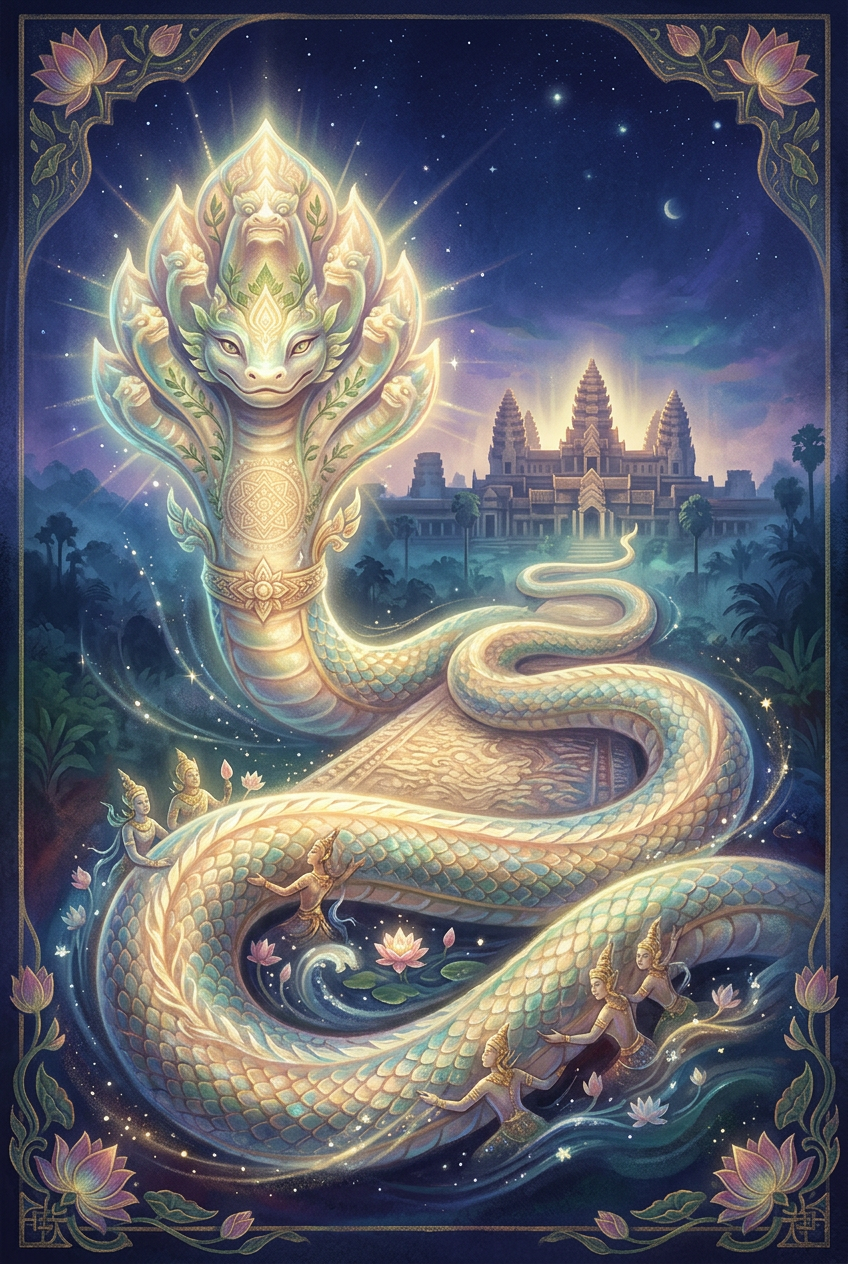
Every great approach at Angkor is flanked by naga balustrades: the serpent's body as the railing of the sacred way, its multiple hoods rearing at the threshold. At Angkor Thom the causeway becomes the Churning of the Ocean in stone — fifty-four gods on one side, fifty-four demons on the other, all gripping the body of the naga Vasuki as they pull: one hundred and eight figures, and the visitor walks the churn itself to enter the city. The Khmer built the doctrine into infrastructure: the way in is over the serpent; the serpent is the rope of transformation; and gods and demons hold the same body, or nothing churns.
The Great Correspondence
Patron SerpentNüwa & Fuxi, serpent-bodied, gave humanity the 64 trigrams. The 64 descends from a serpent's hand. Here are this serpent's threads in the lattice.
«Gathering Together: fifty-four gods and fifty-four demons on one serpent's body — nothing churns unless everyone pulls.»
Say it to wake it: “I remember you.”
The SGE Reading
Integration as architecture: the threshold requires both teams pulling one serpent — exclusion of either stops the churn.
Canon Resonance
The built form of the series' method: enter every sanctuary along the serpent, with your gods and demons on the same rope.
A Micro-Practice
Before your next threshold (job, home, vow), list your 54 'gods' and 54 'demons' — okay, five of each — and assign all ten to the rope.
Sources & Respect
Angkor Thom south gate; Angkor Wat bas-reliefs of the Churning.