Ouroboros
The tail-eating serpent circling the words 'the One, the All' — eternity as a closed circuit of self-renewal.
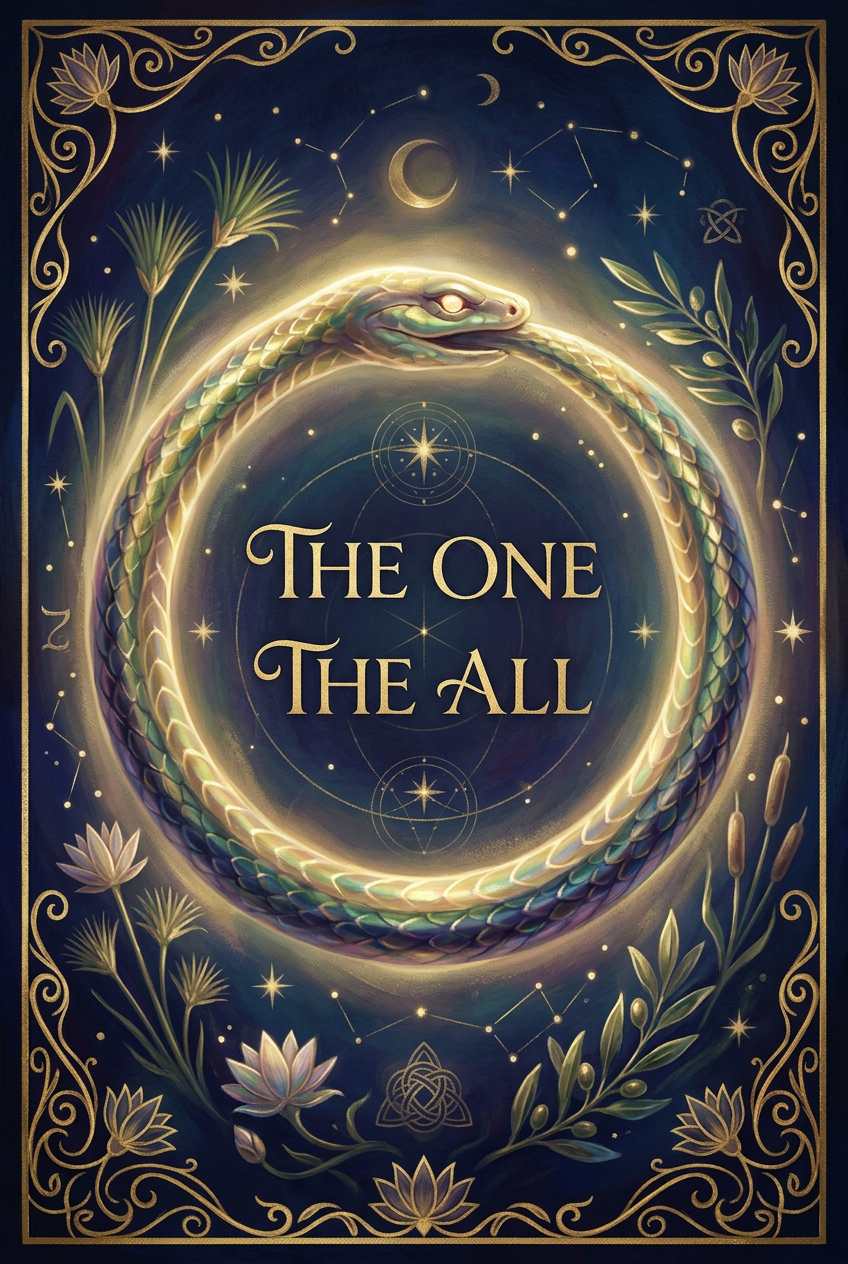
The earliest known Ouroboros encircles figures on the gilded shrines of Tutankhamun — eternity guarding the sleeper. Passing into Greek alchemy, the tail-eater appears in the Chrysopoeia of Cleopatra drawn around the words hen to pan: 'the One, the All.' It became Western alchemy's master-symbol: the closed circuit of energy, ending where it begins, transformed; the prima materia that consumes and regenerates itself. Jung read it as the self-containment of the psyche's deep process — the work that feeds on its own completion.
What does the ouroboros mean? Across three thousand years the answer stays remarkably stable: a beginning that is also an end, and a thing that survives by consuming itself. The image is first attested in the Enigmatic Book of the Netherworld in the tomb of Tutankhamun (c. 1323 BCE), where two tail-eaters ring the head and feet of a great figure — time closed around the sleeper so that he can be reborn inside it. Egypt read the serpent as the boundary of the ordered world, the horizon of mehen coiled protectively around what must not be dispersed.
Greco-Egyptian alchemists in Roman Alexandria inherited the sign and gave it its motto. In the Chrysopoeia of Cleopatra the circle is drawn half black, half light, with hen to pan — the One, the All — written inside: matter and spirit are the same substance seen at different points of one rotation. From there the ouroboros passes into Islamic and European alchemy as the emblem of the opus circulare, the work that distils, condenses and re-distils the same material until it changes state. Norse myth gives the same coil a cosmic body in Jörmungandr, the world serpent whose grip on its own tail is what keeps the sea in place until Ragnarök.
Modern readings add a psychological turn. Jung took the ouroboros as the image of a process that is its own nourishment — the psyche integrating what it has cast out, "slaying itself and bringing itself to life" in a single motion. As an ouroboros symbol of eternity it is easy to sentimentalise; the older meaning is harder and better. The circle does not promise that nothing ends. It promises that the ending is the entrance.
In the Nine Paths canon the ouroboros is the Essence stage of the serpent arc: not the serpent defeated and not the serpent adored, but the serpent completing the circuit — the ninth path arriving where the first began.
The Great Correspondence
The Night WatchNüwa & Fuxi, serpent-bodied, gave humanity the 64 trigrams. The 64 descends from a serpent's hand. Here are this serpent's threads in the lattice.
«The Tail mansion could belong to no one else: the serpent whose mouth holds its own tail closes the dragon's body into a circle.»
The SGE Reading
Integration's final image: the path ends where it began, and the ending is the nourishment of the next beginning.
Canon Resonance
The series' closing geometry: nine paths that curve, at the summit, into one circle.
A Micro-Practice
Revisit where a finished chapter of your life began. Write one sentence on what the ending fed.
Sources & Respect
Tutankhamun shrine iconography; Greco-Egyptian alchemical manuscripts.