Aido Hwedo
The rainbow serpent who coiled beneath the finished world, tail in mouth, to hold it together — and who must be fed.
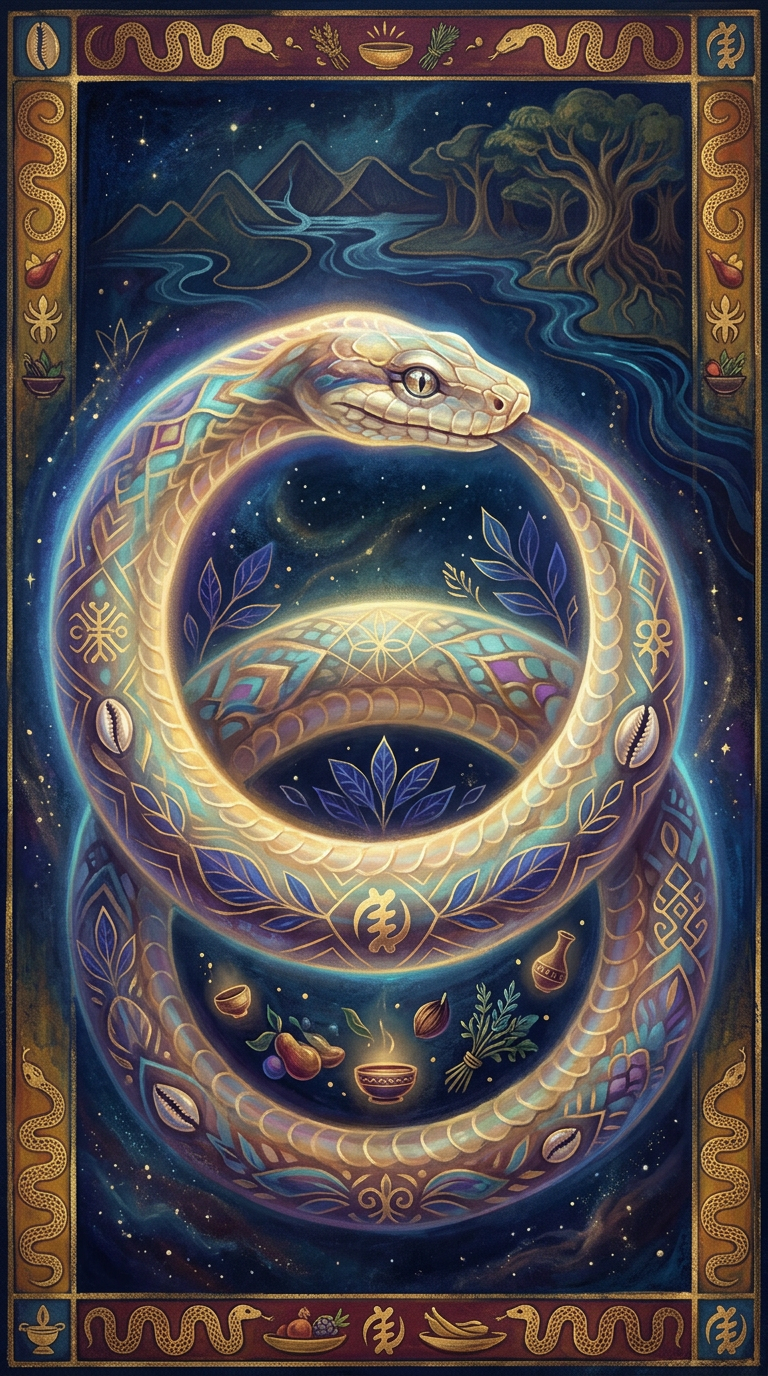
Before the earth, Aido Hwedo carried the creator Mawu in its mouth; mountains rose where they rested, and the winding of rivers remembers the serpent's passage. But the finished world was too heavy — so Aido Hwedo coiled beneath it, tail in mouth, becoming the living ring on which everything rests. The tradition adds the practical wisdom: the serpent must be fed red iron, for if it grows too hungry it will swallow its own tail in earnest and the world will slip. The cosmos is not a machine; it is a relationship that must be maintained.
Aido Hwedo (also Dan Ayido Hwedo, and Damballa Wedo in the Vodou of Haiti) comes from the Fon of Dahomey, present-day Benin. In the beginning the serpent carried the creator Mawu-Lisa in its mouth as the world was made; wherever they stopped, mountains rose, and the winding of every river still traces the path the serpent took. The serpent's dung, the tellings say, became the mountains — which is why the earth's high places hold treasure and minerals.
Then came the problem of weight. The finished world was too heavy to stand, so Mawu asked Aido Hwedo to coil beneath it and hold. The serpent lies there now in the cosmic sea, tail in its own mouth, an ouroboros functioning as a foundation. Because the serpent cannot bear heat, the sea was made cool around it; because it must eat, the red iron of the ocean floor is its food, forged and supplied by celestial smiths. And here the myth becomes a warning: when the iron runs out, the serpent will begin to chew its own tail in earnest, and the world will slide into the sea.
Few cosmologies state their contingency this plainly. The world does not rest on a law or a proof; it rests on a living creature that has to be fed. Stability is not a property of the universe but an ongoing act of provision — a piece of West African theology that reads, in a century of exhausted resources, less like myth than like accounting.
In the Nine Paths reading, Aido Hwedo is Essence that still requires maintenance. Read against Ouroboros, the difference is instructive: the Greek-Egyptian circle is eternity as self-sufficiency, while the Fon circle is eternity as dependency. Whatever holds your life together — the practice, the vow, the relationship — is not a structure. It is a being, and it is hungry.
The Great Correspondence
Patron SerpentNüwa & Fuxi, serpent-bodied, gave humanity the 64 trigrams. The 64 descends from a serpent's hand. Here are this serpent's threads in the lattice.
«Duration: coiled beneath the world since the first day, fed iron by the sea, holding everything up — endurance itself.»
Say it to wake it: “I remember you.”
The SGE Reading
Integration with maintenance clause: the foundation is alive, generous, and has needs. Feeding it is the sacred act.
Canon Resonance
The world-holding octave of the Ouroboros: eternity not as symbol but as someone doing the holding, on purpose.
A Micro-Practice
Choose one foundation of your life — health, a friendship, the land you live on. Feed it something concrete this week.
Sources & Respect
Fon cosmology of Dahomey (Benin); ethnographic collections.
Fon religion is living tradition, ancestor to Vodun; present with accuracy and respect.