Bakunawa
The sea-serpent who rose to swallow the moons — driven back, at each eclipse, by the noise of the whole village.
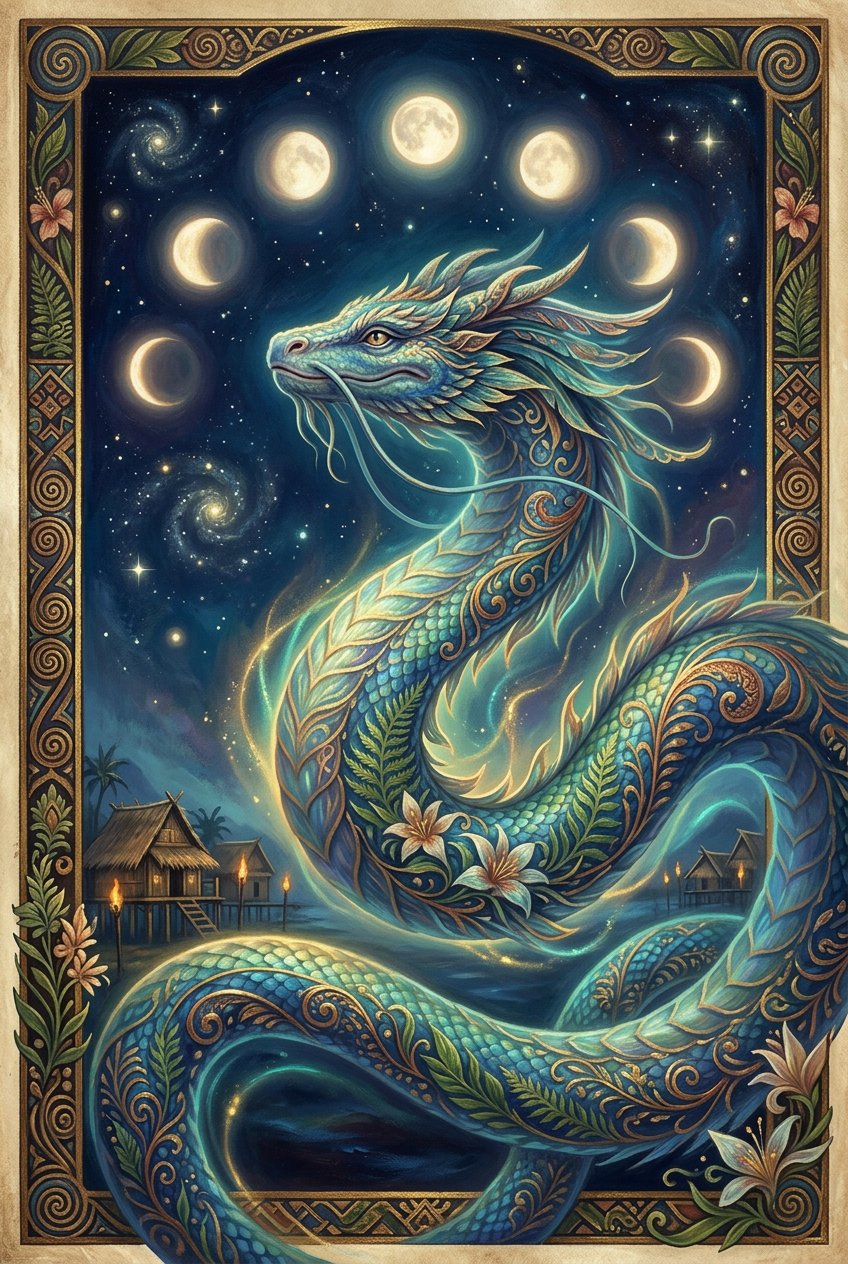
In Visayan tellings, the sky once held seven moons, and the immense sea-serpent Bakunawa, enamored or enraged, rose and swallowed them one by one until a single moon remained. At every eclipse the drama returns: Bakunawa's mouth closes over the last moon — and the people answer, banging pots, drums and gongs, shouting the serpent back into the sea until the light is released. The eclipse as community practice: the devouring dark is not fought by heroes but repelled by everyone, together, making noise — and the moon is returned every single time. The oldest attendance record in the cosmos: the whole village, versus the swallowing, undefeated.
Bakunawa — the name is usually read as "bent" or "curved serpent" — belongs to the Visayan islands of the central Philippines, and the story is one of the clearest eclipse myths in world mythology. Seven moons hung in the early sky. The serpent rose from the sea, drawn by their light, and swallowed them one after another. When it came for the last, the people made noise: pots, gongs, drums, bamboo, shouting, dogs set barking — and the serpent, startled, released the moon back into the sky.
Different islands tell it differently. In some versions Bakunawa is a woman-turned-serpent who fell in love with the moon and swallowed her out of longing; in others it is the youngest of Bathala's creations, wronged and vengeful. Some tellings hold that the last moon survives only because Bathala planted bamboo on its face — the shadowed patches Filipinos still point to — to make it unpalatable. In several accounts the serpent's hunger is not evil at all, merely appetite of a scale no household can imagine.
What makes the Bakunawa myth distinct among dragon myths is who resolves it. There is no hero, no spear, no chosen one. The eclipse ends because everyone in the village stands outside and makes noise at the same time. Compare Jörmungandr, killed by Thor at the cost of Thor's own life, or the dragon of Beowulf, met by a king alone. Here the monster is repelled by collective racket — the only weapon everybody already owns.
In the Nine Paths reading, Bakunawa is the Shadow that returns on schedule and is answered on schedule. Some darknesses are not defeated once; they are met again and again, and the meeting is the practice. What the tradition offers is not a slain serpent but an undefeated attendance record: every eclipse in recorded memory has ended, and the moon has come back every single time.
The Great Correspondence
The Night WatchNüwa & Fuxi, serpent-bodied, gave humanity the 64 trigrams. The 64 descends from a serpent's hand. Here are this serpent's threads in the lattice.
«Emptiness is the swallower's mansion: six moons gone, one remaining — and the whole village on duty every eclipse.»
The SGE Reading
Shadow met communally: the devourer retreats before collective voice — no champion required, only everyone, and every time.
Canon Resonance
For the series' collective rituals: some darknesses are calibrated to yield only to the whole village at once.
A Micro-Practice
Next time a shared darkness looms (in family or team), convene everyone and make 'noise' together — one meeting, all voices.
Sources & Respect
Visayan oral tradition; Philippine eclipse customs.