The Phaya Naga
The great naga of the Mekong, honored each October when fireballs are said to rise from the river.
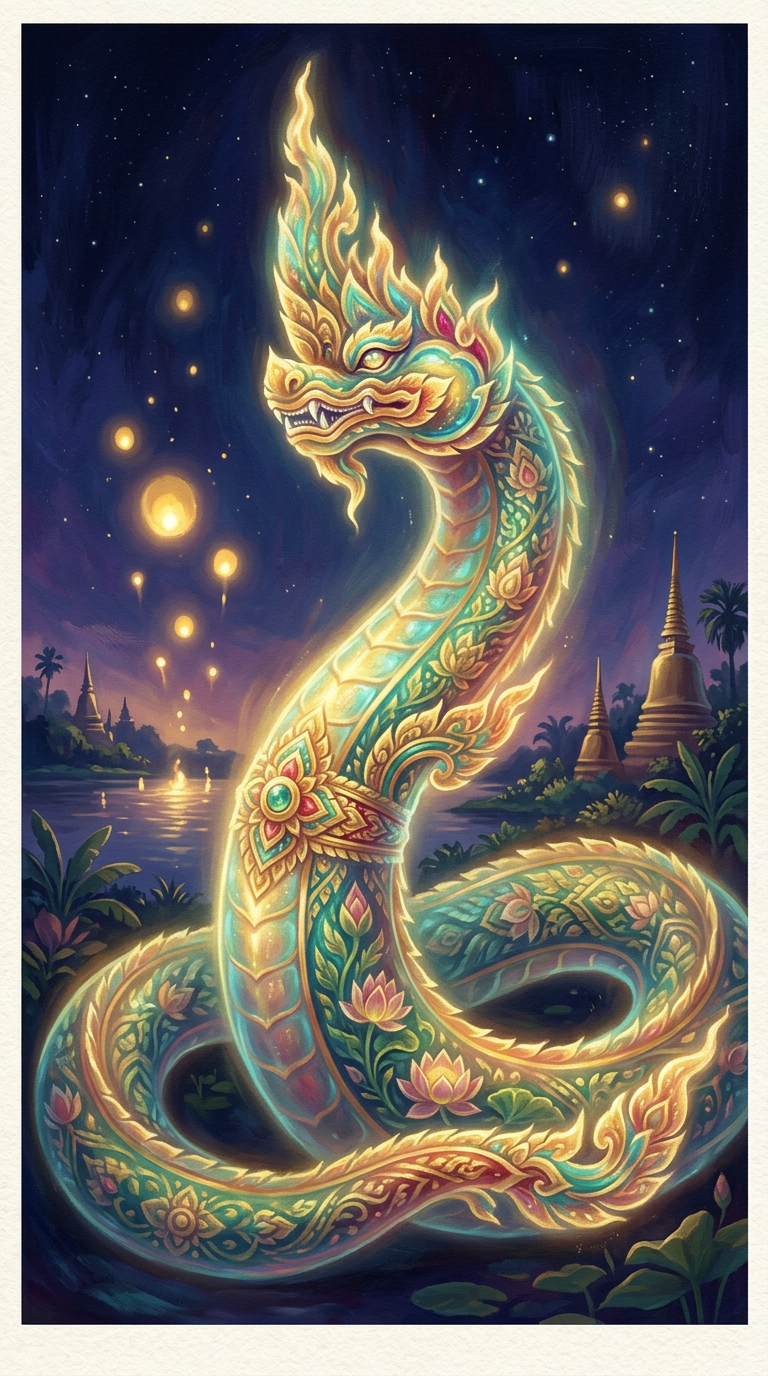
Along the Mekong, the Phaya Naga — the serpent lords of the river — are living presence, not literature: protectors of the water, of the Buddha's dharma, and of the people on both banks. At the end of Buddhist Lent each October, crowds gather at Nong Khai and along the Lao shore to watch the bung fai phaya nak — the naga fireballs — reddish lights said to rise silently from the river into the night sky: the naga's homage to the Buddha's descent. Explanations are debated; the reverence is not. A river that is also a being, saluting the sacred once a year, with witnesses in the hundreds of thousands.
Nagas are the great serpent beings of Indian, Buddhist and Southeast Asian cosmology: guardians of water, treasure and threshold, capable of taking human form, dangerous when disrespected and generous when honoured. Along the Mekong they are called Phaya Naga — naga lords — and they are not archaic literature but present tense. Temples in Laos and Isan Thailand are entered along naga balustrades; boats are blessed in their name; villagers speak of them the way one speaks of a landlord who is also a neighbour.
The best-known naga story in Buddhism is Mucalinda, the serpent king who raised his hood over the meditating Buddha through seven days of storm. That gesture — the serpent as shelter rather than threat — set the pattern for the whole region. The naga is the power of the water world consenting to protect the dharma, and the Mekong, in this telling, is not a resource but a sovereign presence with obligations of its own.
Every October, at the end of Buddhist Lent, the bung fai phaya nak — the naga fireballs — draw enormous crowds to Nong Khai and the Lao bank opposite. Reddish lights are seen to rise silently from the river into the night. Scientists have proposed marsh-gas ignition and other explanations; sceptics have proposed tracer fire from the far shore. The debate has run for decades without denting the observance, because for the people on the bank the question is not what produces the light but who is being honoured.
In the Nine Paths reading, the Phaya Naga is the Gift stage in its civic form: a serpent that keeps a river's law and receives a river's thanks. It also poses the sharpest question in this library to a modern reader — whether a river treated as a person can be poisoned as easily as a river treated as a supply. The dams, the fisheries, the falling water levels: the naga's protection is now, in effect, an ecological argument told in the older grammar.
The Great Correspondence
Patron SerpentNüwa & Fuxi, serpent-bodied, gave humanity the 64 trigrams. The 64 descends from a serpent's hand. Here are this serpent's threads in the lattice.
«Fellowship: a river that is a being, honored by two nations at once, crowds gathered on both banks each October.»
Say it to wake it: “I remember you.”
The SGE Reading
Gift as living covenant: the river's power honored annually, publicly, and in return the water remains kin, not hazard.
Canon Resonance
'Bring it to the river': the Mekong keeps, at national scale, the ritual grammar of the first egg.
A Micro-Practice
Adopt one annual appointment with a body of water near you — same date, small offering of attention, every year.
Sources & Respect
Mekong naga traditions; Nong Khai fireball festival documentation.
Living devotion in Laos and Thailand; report the phenomenon respectfully, without debunking or credulity.