The Caduceus of Hermes
Two quarreling serpents, reconciled around the messenger's staff — the emblem of safe passage between worlds.
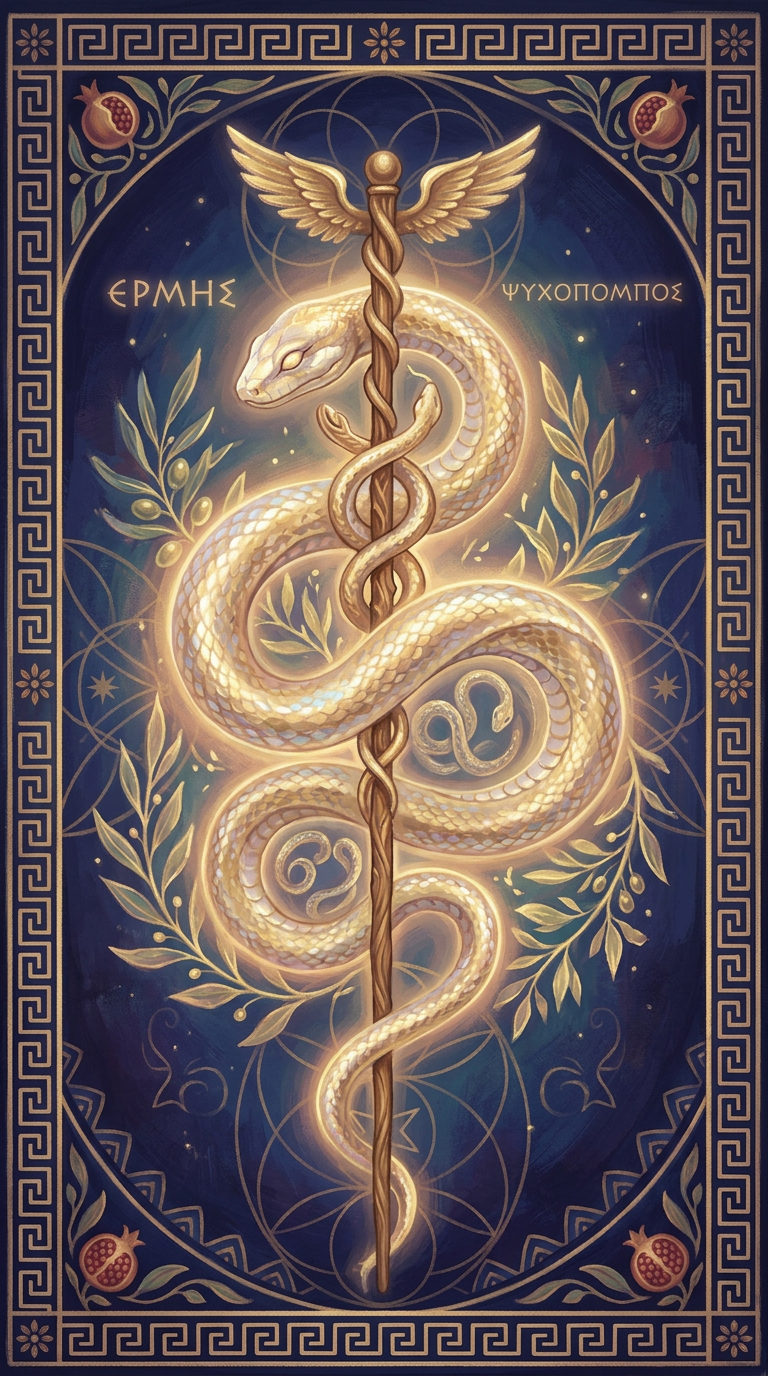
Tradition tells that Hermes came upon two serpents fighting and cast his staff between them; they twined around it in balance, and the caduceus was born — the winged wand of the god of messengers, merchants, travelers, thresholds, and the guiding of souls. Its geometry is the ancient twin-current diagram (Ningishzida's vase, ida and pingala) wearing a Greek name: opposites reconciled around an axis, crowned with wings. Long confused with Asclepius' single healing serpent, the caduceus is properly the emblem of passage: whoever carries the reconciled opposites may cross any border — even the last one.
The Great Correspondence
Patron SerpentNüwa & Fuxi, serpent-bodied, gave humanity the 64 trigrams. The 64 descends from a serpent's hand. Here are this serpent's threads in the lattice.
«Dispersion: the staff cast between two fighting serpents dissolves the knot — enmity reorganized into an emblem of passage.»
Say it to wake it: “I remember you.”
The SGE Reading
Integration as passport: reconcile the two quarreling currents and every threshold — social, inner, final — opens to you.
Canon Resonance
Elena the interpreter carries an invisible caduceus: her work is the reconciled crossing between worlds of meaning.
A Micro-Practice
Before mediating any conflict, silently place 'the staff between the serpents': name both positions fairly to yourself first.
Sources & Respect
Homeric Hymn to Hermes; classical iconography of the kerykeion.