The Rainbow Serpent
Known by many names in many nations, the being whose body made the rivers and gorges — and who remains in the deep waterholes, guarding water and law.
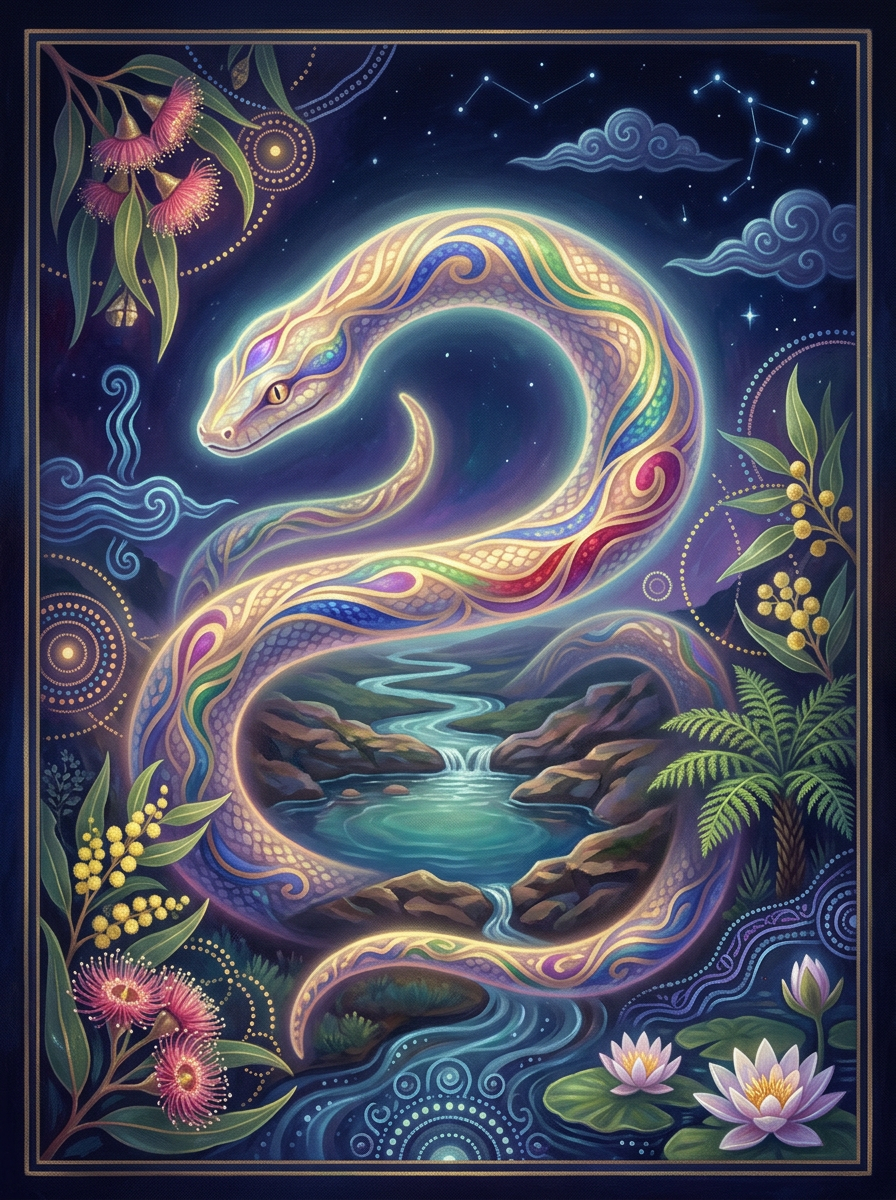
Across Aboriginal Australia — home of what may be humanity's oldest continuous religious tradition — the being outsiders call the Rainbow Serpent appears in rock art and ceremony reaching back thousands of years: Ngalyod to the Kunwinjku of western Arnhem Land, the Wagyl to the Noongar, among many names, each belonging to its own country and law. In the Dreaming, the great serpent moved through the land and its body made the water places — carving rivers, deepening gorges — before coiling down into the permanent waterholes where it remains. The land is not guarded by the serpent; it is the serpent's biography, and approach is a relationship: one is introduced to the water by those who belong.
The Rainbow Serpent is not one myth but many. Ngalyod in western Arnhem Land, the Wagyl in Noongar country around the Swan River, Yingarna, Almudj, Kanmare, Goorialla — each name belongs to a nation, a language and a stretch of country, and no single account speaks for all of them. What the outsider's phrase "Rainbow Serpent" gathers together is a family resemblance: an immense ancestral being associated with water, rain, the shimmer on a wet rock face, the arc that stands after storm, and the deep permanent waterholes that hold water through drought.
In the Dreaming — better rendered as the everywhen, since it is not a past age but an ongoing law — the serpent travelled, and its travelling made the shape of the country: rivers as its track, gorges as the places it pushed through, billabongs as the places it rested. This is why the meaning of the Rainbow Serpent cannot be separated from a map. To learn the story is to learn where the water is, who may drink there, and what must be said on arrival. The rock art at sites in Arnhem Land carries these figures back some six thousand years and further, which makes this among the oldest continuously told stories on earth.
The serpent is also law, and law has teeth. Many tellings warn that the being punishes those who take water carelessly, foul a soak, or approach a sacred site unannounced and uninvited; floods and sickness follow. Read plainly, this is water governance encoded as awe — a drought continent's oldest conservation instrument, held not by fences but by fear, respect and belonging.
In the Nine Paths reading, the Rainbow Serpent sits at Essence: the stage at which the serpent is no longer a figure in the landscape but the landscape itself. It teaches the last lesson of the whole library — that the sacred is not visited, it is inhabited, and the right relationship with it is not worship but conduct. Non-Aboriginal readers meet these stories as guests: they belong to living peoples who still hold them, and the correct posture is attention, attribution and restraint.
The Great Correspondence
The Night WatchNüwa & Fuxi, serpent-bodied, gave humanity the 64 trigrams. The 64 descends from a serpent's hand. Here are this serpent's threads in the lattice.
«The Extended Net is the arc flung across the whole sky — the Rainbow Serpent's body stretched from horizon to horizon.»
The SGE Reading
Essence as landscape: the most complete identification of serpent and world in human tradition — the ground itself is the being, owed courtesy.
Canon Resonance
'I remember you' is, structurally, a songline greeting: announcement, relationship, and permission before approach.
A Micro-Practice
Before entering any natural water this year, pause at the edge and introduce yourself — silently, sincerely — first.
Sources & Respect
Rock art scholarship of Arnhem Land; statements by Aboriginal custodians and nations.
Living law, not 'myth': name specific nations, defer to custodians, and do not reproduce restricted designs or stories.