Āstīka
The boy — half Brahmin, half serpent — who stopped the great snake sacrifice with a single well-earned request.
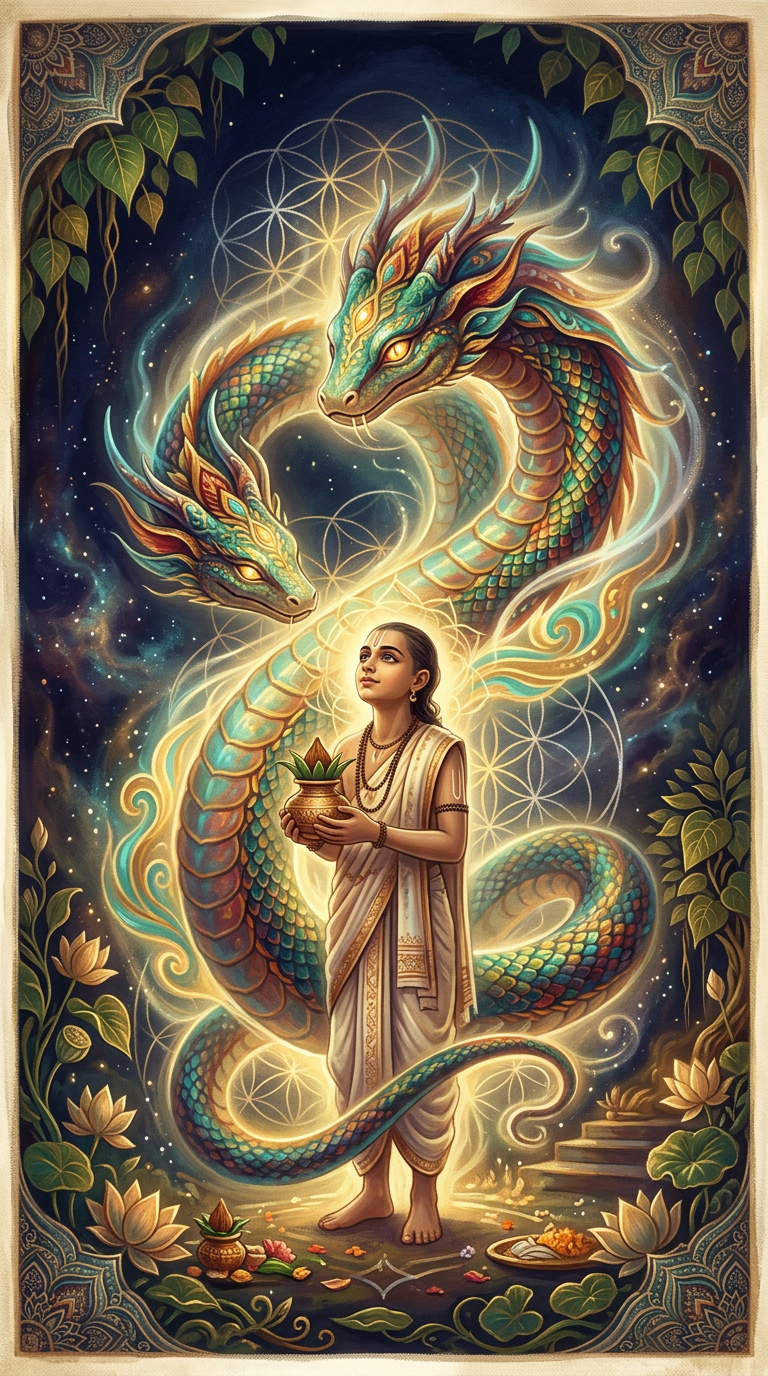
King Janamejaya, avenging his father's death by snakebite, holds the sarpa satra: a sacrificial fire into which the mantras drag every serpent of the world, species by species, toward extinction. Into the hall walks Āstīka — son of a Brahmin father and the serpent-maiden Jaratkaru — a boy of both houses. He praises the rite so perfectly that the king grants him one boon; he asks that the sacrifice stop. Bound by his word, Janamejaya halts the fire, and the serpents are saved. The Mahabharata's peace teaching: the war between houses is ended by the child who belongs to both — and Nag Panchami keeps the memory green.
The Great Correspondence
Patron SerpentNüwa & Fuxi, serpent-bodied, gave humanity the 64 trigrams. The 64 descends from a serpent's hand. Here are this serpent's threads in the lattice.
«Peace arrives through the one who belongs to both houses: the boy of serpent and Brahmin blood who stopped the fire.»
Say it to wake it: “I remember you.”
The SGE Reading
Integration personified: only what belongs to both sides can end the fire. The peacemaker's power is dual citizenship.
Canon Resonance
The mediator archetype of the series: every reconciliation needs its Āstīka — the one made of both houses.
A Micro-Practice
In a conflict you witness, locate your dual citizenship — what you honestly share with each side — and speak from there once.
Sources & Respect
Mahabharata, Adi Parva (Āstīka Parva); Nag Panchami tradition.