The Dragon in the Genome
The hypothesis that the dragon is humanity's compiled memory of everything that ever hunted it — serpent, raptor, and cat in one body.
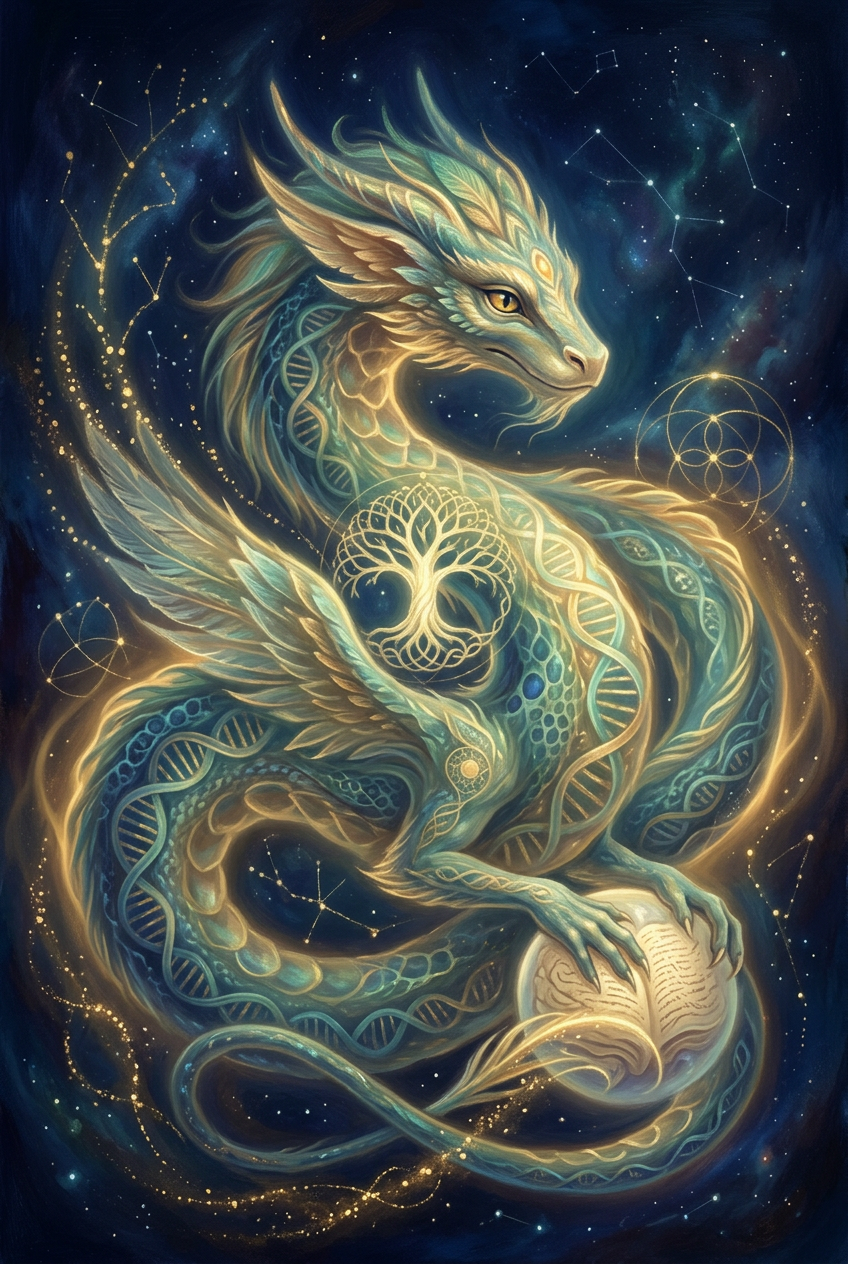
Why does every culture, without contact, draw the same impossible animal? Anthropologist David E. Jones proposed the dragon is a composite of the three predator classes that hunted our primate lineage — serpent, raptor, big cat (vervet monkeys keep distinct alarm calls for exactly these three). Lynne Isbell's snake detection hypothesis argues serpents helped sharpen primate vision itself. Carl Sagan took it inward: we carry the inheritance of the long war in the oldest circuitry of the brain (the tidy 'reptilian brain' is retired, but the fast, ancient threat system is real). Hypotheses, duly hedged — and together they make dragon-lore the autobiography of a prey animal that made it.
The Great Correspondence
Patron SerpentNüwa & Fuxi, serpent-bodied, gave humanity the 64 trigrams. The 64 descends from a serpent's hand. Here are this serpent's threads in the lattice.
«Inner Truth: the oldest testimony is written inside us — the serpent coiled in our own nervous system, awaiting honest reading.»
Say it to wake it: “I remember you.”
The SGE Reading
Shadow located: the dragon moved indoors — the ancestral alarm system firing in a world that no longer matches its manual.
Canon Resonance
'The dragon in your genome roars. Who tamed it?' — the series' koan, and its evolutionary ground.
A Micro-Practice
Next time fear fires, name the ancient trio silently — snake, eagle, leopard — then look at what is actually in front of you.
Sources & Respect
D. E. Jones, An Instinct for Dragons; L. Isbell's snake detection hypothesis; C. Sagan, The Dragons of Eden (with current caveats).
Present as serious, contested hypotheses — not settled science.