Taktsang & Guru Rinpoche — Binding Demons as Protectors
Guru Rinpoche did not destroy the demons — he bound them by oath as protectors of the teaching. Every wrathful spirit met was enrolled as a dharmapala.
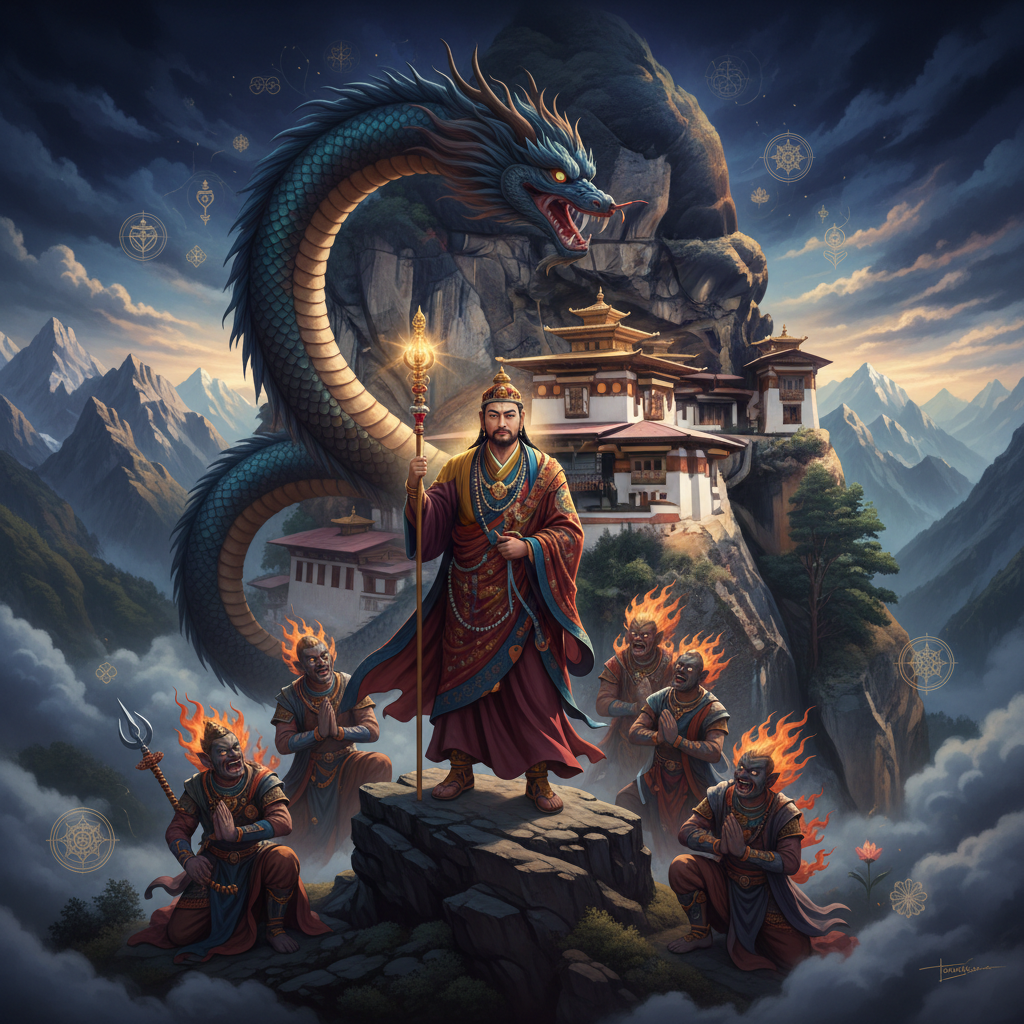
Clinging to a cliff face nine hundred meters above the Paro valley hangs **Paro Taktsang, the Tiger's Nest** — built around the caves where **Guru Rinpoche (Padmasambhava)**, the master who carried Buddhism across the Himalayas, arrived in the eighth century *flying on the back of a tigress* — the tigress being, in the tradition, his consort **Yeshe Tsogyal** in transformed shape. He meditated in the cliff caves and subdued the local spirits and demons of the land. The verb matters more than the miracle: Guru Rinpoche's signature method was **not to destroy the demons but to bind them by oath as protectors of the teaching**. Every wrathful local spirit he met was tamed, given a task, and enrolled as a *dharmapala*, a guardian. This is the most explicit shadow-integration doctrine in world religious history: the monster is not slain nor merely endured but *converted into the guardian of the very treasure it once threatened*.
The SGE Reading
Essence stage as *missionary method*: the Himalayan tradition institutionalized the SGE arc. Every wrathful spirit met gets a job. Nothing is wasted.
Canon Resonance
The saga's operational doctrine: never destroy, always assign.
A Micro-Practice
Name one shadow you have been fighting. Ask, seriously: *what job would this shadow do beautifully, if I gave it a task?* Assign it — even provisionally, for a week.
Sources & Respect
Nyingma lineage biographies of Padmasambhava; Keith Dowman, *The Legend of the Great Stupa*.
Living Vajrayana tradition. Taktsang is an active pilgrimage site; Guru Rinpoche and Yeshe Tsogyal are venerated deities.