Quetzalcóatl
The plumed serpent who gave humanity maize, the calendar and books — and created this era's people by offering his own blood.
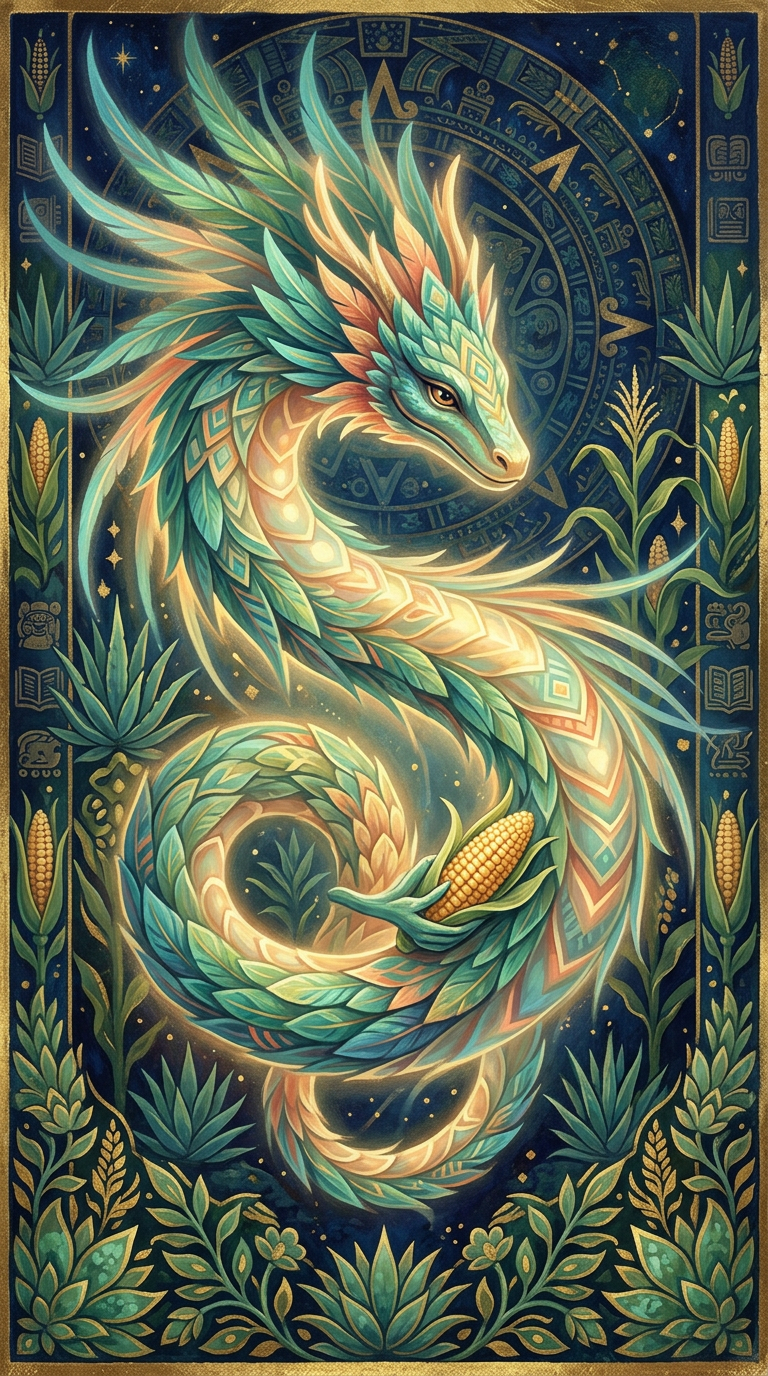
Quetzal (iridescent sky-bird) plus cóatl (serpent): the central-Mexican name of the being in whom opposites are one body. Quetzalcóatl is the culture-bringer — maize, arts, calendar, books — who descends to Mictlan, the underworld, and sprinkles his own blood on the bones of past humanities to create the people of this era. His adversary Tezcatlipoca, the smoking mirror, tricks him into beholding his own shadow, and his fall and promised return became one of history's most consequential prophecies.
Quetzalcoatl is not one figure but a lineage of them. There is the deity of the Feathered Serpent, whose stone coils run along the Temple of the Feathered Serpent at Teotihuacan centuries before the Mexica; there is Ce Acatl Topiltzin Quetzalcóatl, the priest-king of Tula remembered as a historical man; and there is Kukulcán, the same being under a Maya name, whose shadow descends the steps of El Castillo at Chichén Itzá on the equinoxes. Feathers and scales in one body: sky and earth refusing to be separate, which is the oldest theology Mesoamerica has.
The defining act is a sacrifice with no enemy in it. In the Leyenda de los Soles, Quetzalcóatl goes down to Mictlan to retrieve the bones of the previous humanities, is tricked and drops them so that they shatter — which is why people come in different sizes — and then bleeds himself over the fragments to make them live. Creation, in this telling, is not command. It is donation. He also brings maize out of the mountain, and the calendar, and the books, and forbids human sacrifice in his city.
His fall is a mirror-story. Tezcatlipoca, the smoking mirror, shows him his own face — aged, unlovely — then offers pulque to soften the sight; drunk, he breaks his vows, and in shame he burns himself on the eastern shore and rises as the morning star, promising to return in a year One Reed. When Cortés landed in 1519, a year One Reed, that promise became one of the most consequential sentences in world history — though modern scholarship treats the neat identification of Cortés with the returning god as largely a post-conquest construction.
In the Shadow · Gift · Essence arc, Quetzalcóatl holds all three at once: the shadow shown in the mirror, the gift given as blood and maize, and the essence that leaves as a star and keeps its appointment.
The Great Correspondence
Patron SerpentNüwa & Fuxi, serpent-bodied, gave humanity the 64 trigrams. The 64 descends from a serpent's hand. Here are this serpent's threads in the lattice.
«Return is his very title: the feathered serpent who departed eastward over the sea, promising to come back.»
Say it to wake it: “I remember you.”
The SGE Reading
Gift through self-offering: creation costs the creator. The unmet shadow (the mirror) is what exiles even a god.
Canon Resonance
The teacher archetype behind the Guides; the mirror episode prefigures every character's first sight of their own shadow.
A Micro-Practice
Identify one creation of yours that required real sacrifice. Thank the part of you that paid for it.
Sources & Respect
Nahua codices and colonial-era chronicles; Teotihuacan and Toltec iconography.