Ningishzida
Lord of the Good Tree — his emblem of two intertwined serpents, carved c. 2100 BCE, is the oldest twin-serpent staff known.
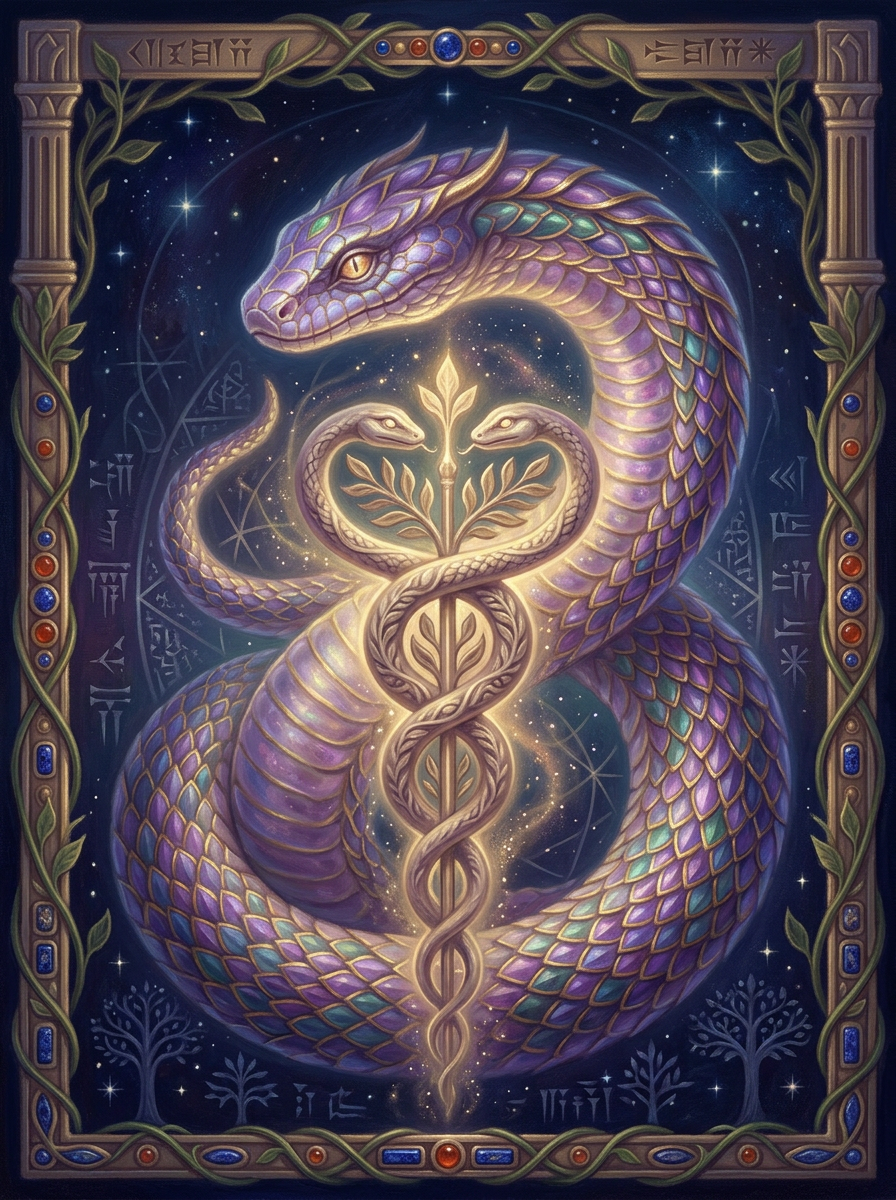
Ningishzida, Sumerian god of the underworld, roots and healing, appears on a libation vase of Gudea of Lagash (c. 2100 BCE) as two serpents intertwined in symmetrical coils around a central staff — two millennia before the Greek caduceus, and structurally identical to yoga's ida and pingala around the sushumna. The oldest surviving image of the twin-current anatomy that traditions across three continents kept redrawing, as if all were sketching the same body from inside.
The Great Correspondence
The Night WatchNüwa & Fuxi, serpent-bodied, gave humanity the 64 trigrams. The 64 descends from a serpent's hand. Here are this serpent's threads in the lattice.
«The Winnowing Basket separates grain from chaff: the twin currents entwined on the oldest vase are discernment itself.»
The SGE Reading
Gift as anatomy: healing pictured as two opposed currents reconciled around one axis — the reconciliation is the medicine.
Canon Resonance
The five-thousand-year pedigree of the serpent of the spine that runs beneath the entire series.
A Micro-Practice
Sit tall. Breathe alternately — left, right — imagining two currents braiding up the spine. Three minutes, no goal.
Sources & Respect
Gudea libation vase (Louvre); Sumerian religious iconography.