Kundalini
The goddess-energy coiled three and a half times, sleeping at the base of the spine — waiting to be *remembered*.
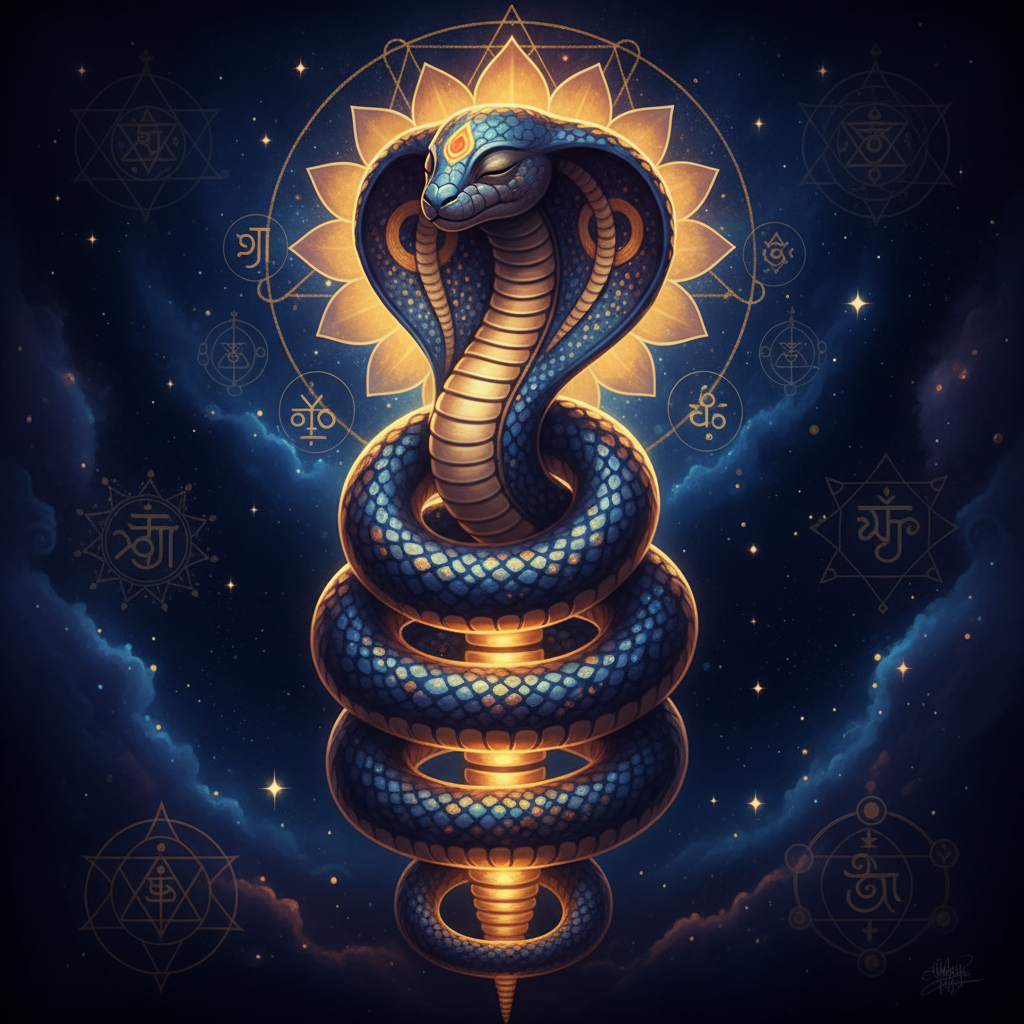
Kundalinī-shakti is the tradition's crown jewel and the canon's secret engine: the goddess-energy described as a serpent *coiled three and a half times, sleeping* at the base of the spine in mūlādhāra. Through practice — breath, mantra, devotion, grace — she wakes and ascends the central channel (sushumna), flanked by the twin currents ida and pingala (the caduceus, the Ningishzida vase), piercing the chakras until she unites with Shiva at the crown: the drop of individual consciousness merging with the All. Every sleeping dragon in every egg in the Nine Paths canon is, at the final octave, Kundalini — and *I remember you* is precisely how she is traditionally awakened: through recognition (*pratyabhijñā*, the "re-cognition" school of Kashmir Shaivism teaches that liberation is simply remembering what you are).
The SGE Reading
Essence stage as *anatomy*: the descending serpent of Chichén Itzá is the ascending serpent of the spine, at the individual scale.
Canon Resonance
The saga's secret engine. All the marble eggs, at the last octave, are her.
A Micro-Practice
Sit tall. Rest attention at the base of the spine for one full breath. Say silently: *I remember you.* Ask nothing else. She hears in her own time.
Sources & Respect
*Vijnana Bhairava Tantra*; *Pratyabhijñāhṛdayam* (Kshemaraja); Gopi Krishna, *Kundalini*.
Living Hindu tantric lineage. Kundalini practice is not decorative; treat this entry as the doorway of a living tradition, not as content.