Kukulcán
The feathered serpent who descends the pyramid twice a year to remind us that light and shadow are one movement.
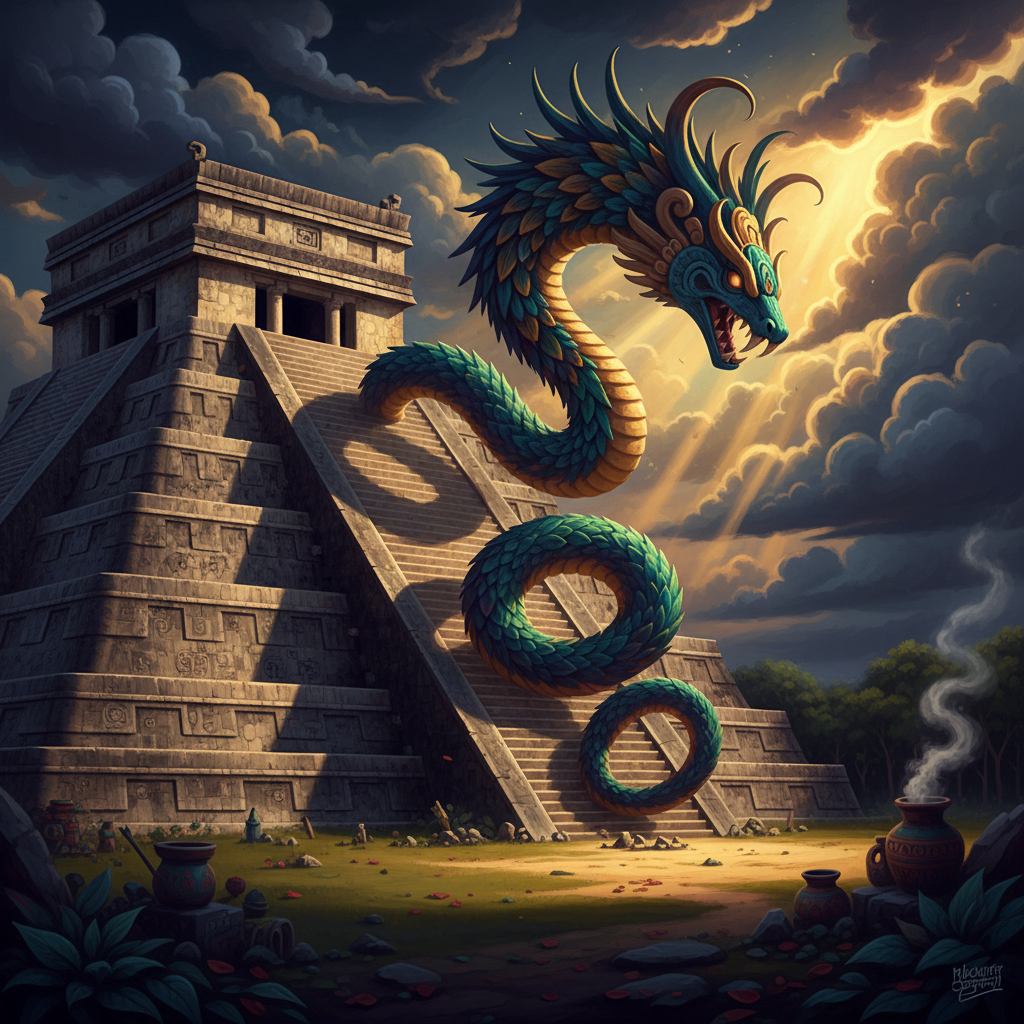
At Chichén Itzá, twice each year, the sun sets against the northern balustrade of the pyramid known as El Castillo and a serpent of light appears to slide down its edge. The Maya called this serpent Kukulcán — feathered, plumed, half sky and half earth. He is not a god of terror but of return: he arrives on the equinoxes, when the day meets the night as equals, and vanishes into the ground as if the pyramid itself were a body being entered.
Kukulcán teaches something the modern eye keeps missing: that descent is a form of blessing. The serpent does not fall from the pyramid — he chooses it. He puts on the shape of a stair. He becomes the path his people will climb. In this he is the twin of Quetzalcóatl, the same figure walking under a different sky, and behind both stands a still older intuition: that the sacred visits us through movement, not through stillness alone.
To meet Kukulcán inside the Nine Paths is to meet the Path of the Root — the willingness to be met at ground level, to let something feathered walk down into your ordinary life instead of demanding you climb to it. His feathers are what keeps the descent gentle. His scales are what keeps it real.
The SGE Reading
Shadow: the belief that what is sacred lives only above us — that we must climb, prove, ascend before we are met.
Gift: the recognition that descent is generosity. Something feathered comes down to where we already are.
Essence: the equinox posture — day and night as equals inside the body, neither one climbing over the other.
Canon Resonance
Kukulcán belongs to the Path of the Root — the first of the Nine Paths, and the movement of a saga that begins by being met at ground level rather than at the summit.
A Micro-Practice
A five-breath descent, at any moment of the day.
1. Stand or sit and feel the ground under your feet without adjusting anything. 2. Inhale, and imagine a feathered thread of attention entering through the crown. 3. Exhale, and let it slide down the spine, one vertebra at a time. 4. Let it pool at the base — quiet, unhurried, present. 5. Open your eyes with the small recognition: I did not have to climb for this.
Sources & Respect
Freidel, Schele & Parker, *Maya Cosmos* (1993). Milbrath, *Star Gods of the Maya* (1999). INAH archaeological notes on the Chichén Itzá equinox phenomenon.
The equinox observance at Chichén Itzá is a living Maya inheritance. Kukulcán is not a metaphor available for casual use — approach him as a guest at a house that is still occupied.