Druk
The Thunder Dragon of Bhutan, whose voice is the storm and whose grip holds the jewels of a country's promise to itself.
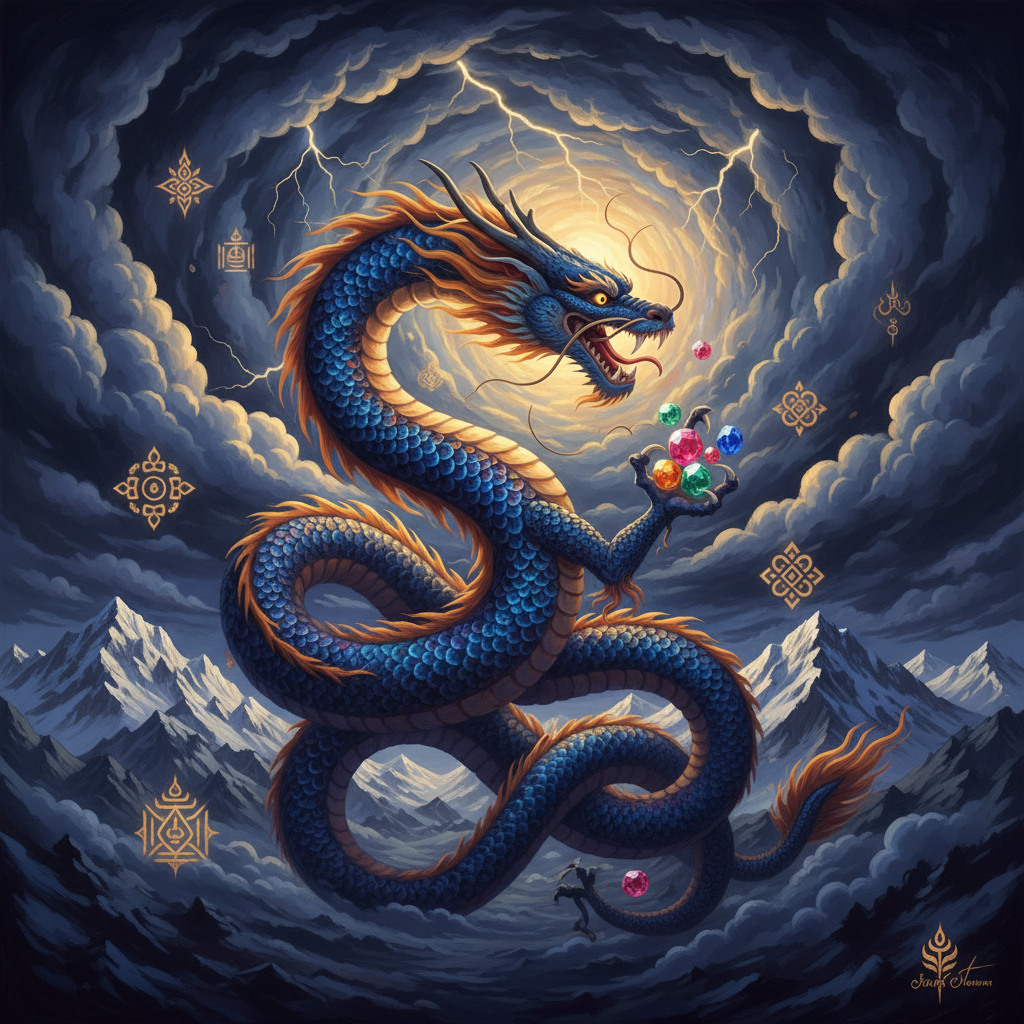
Bhutan calls itself Druk Yul — the Land of the Thunder Dragon. On the national flag Druk holds a jewel in each of its four claws. The jewels are not treasure in the ordinary sense; they are the four promises of a country that has chosen, again and again, to measure its life by happiness before wealth. Thunder is his voice. When it rolls through the valleys of the Himalaya, Bhutanese elders will still tell you, softly, that Druk is speaking.
Druk is not a dragon of conquest. He does not hoard, does not burn villages, does not sleep on gold. He is a guardian who has agreed, over centuries, to hold something on behalf of a whole people — a way of life, an idea of dignity, a small honest measurement (Gross National Happiness) that the wider world is only beginning to take seriously. He is what a dragon becomes when a culture asks it to protect meaning rather than accumulate power.
Inside the Nine Paths, Druk stands at the end — the Path of the Mender. He teaches that integration is not a private feat. It is what happens when a community, or a country, or a single life agrees to hold its jewels openly, without letting the storm frighten it into closing its hands.
The SGE Reading
Shadow: the fear that if you hold something openly — a value, a love, a measurement — the thunder will come and take it.
Gift: the composure of the guardian: keeping the jewel visible even while the storm speaks.
Essence: integration as public posture, not private secret — Gross National Happiness inside a single life.
Canon Resonance
Druk belongs to the Path of the Mender — the ninth of the Nine Paths, and the closing motion of a saga that ends not in triumph but in openly held jewels.
A Micro-Practice
A four-jewel check-in, once a day.
1. Name four things you are guarding right now — a value, a person, a promise, a small honest measurement of your own life. 2. Open your hands, palms up. 3. Assign one to each palm and each fingertip pair, silently. 4. Notice which ones you are tempted to close a fist over. Let them stay open a breath longer. 5. Close your hands only when the day is done.
Sources & Respect
Ura & Galay (eds.), *Gross National Happiness and Development* (Centre for Bhutan Studies, 2004). Aris, *Bhutan: The Early History of a Himalayan Kingdom* (1979). Public materials of the GNH Centre Bhutan.
Druk is a living national and spiritual symbol of the Kingdom of Bhutan. Speak of him with the same respect you would ask of a guest speaking about your own home.