Lóng — The Chinese Dragon
The Chinese dragon inverts the Western valence: almost wholly auspicious — rain-bringer, ancestor, emperor's emblem, eternal chaser of the flaming pearl.
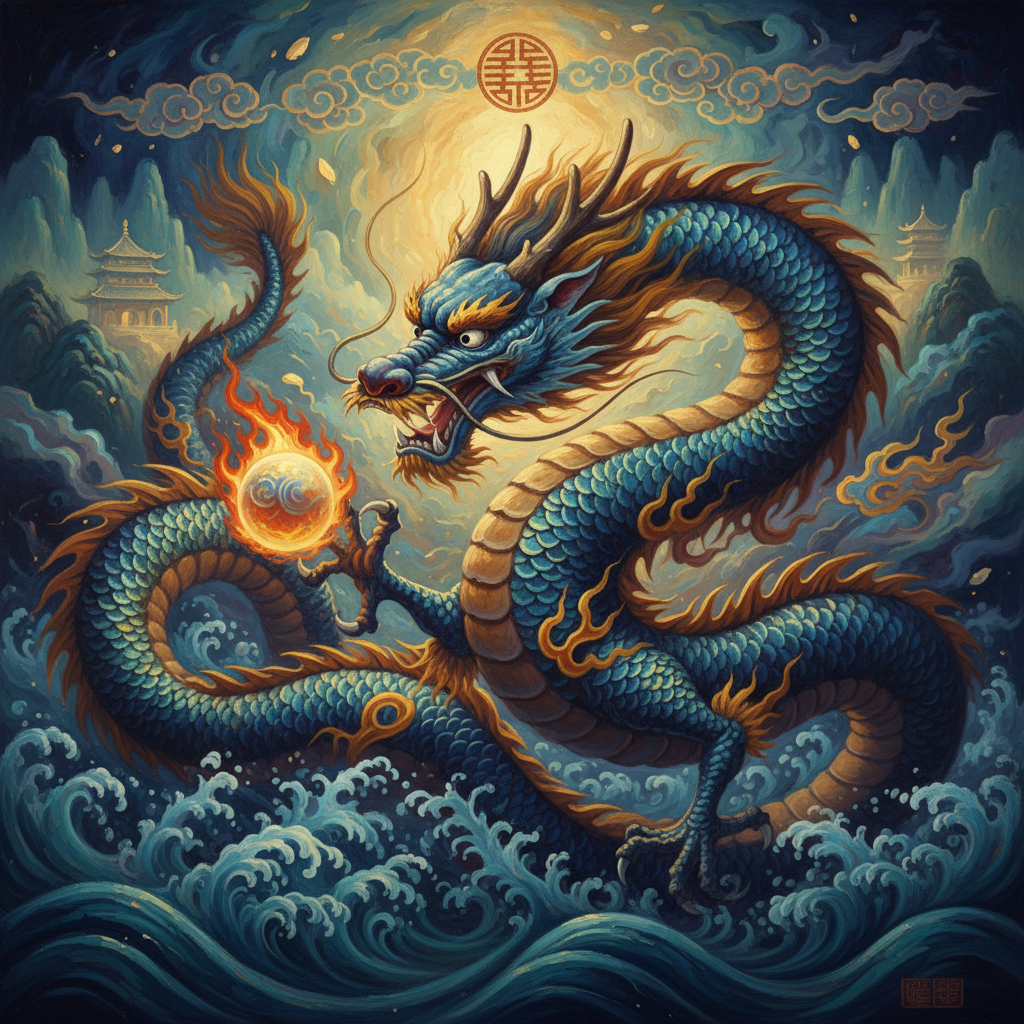
In China the tradition inverts the Western valence entirely: the dragon is almost wholly auspicious — rain-bringer, river-spirit, emblem of the emperor, ancestor of the people ("descendants of the dragon"). The Azure Dragon of the East governs spring and the dawn quadrant of the sky; Dragon Kings rule the four seas from crystal palaces; dragon veins (*lóng mài*) carry the qi of the land through mountains — feng shui is literally the art of living well on the dragon's body. The classic image of the **dragon chasing the flaming pearl**: the pearl is variously the moon, thunder, wisdom, the pearl of potentiality — the dragon eternally pursuing the luminous egg. And the proverb *huà lóng diǎn jīng* — "paint the dragon, dot the eyes": the master painter's dragons flew away when he dotted their pupils. The final touch of consciousness brings the image to life.
The SGE Reading
Essence stage as *cultural default*: an entire civilization that never needed to demonize the serpent.
Canon Resonance
The saga's Eastern counter-testimony: the dragon can be, from the start, home.
A Micro-Practice
Think of one thing you have always assumed had to be feared. Ask: *what if a whole other civilization would have called this auspicious?*
Sources & Respect
*Shan Hai Jing*; *Zhouyi*; Zhang Sengyou's dragon-eye legend (*Lidai Minghua Ji*).
Living Chinese tradition, from cosmology to New Year iconography.