Beowulf's Dragon
The hoard-dragon woken by a single stolen cup — and the aged king who spent his life to meet it.
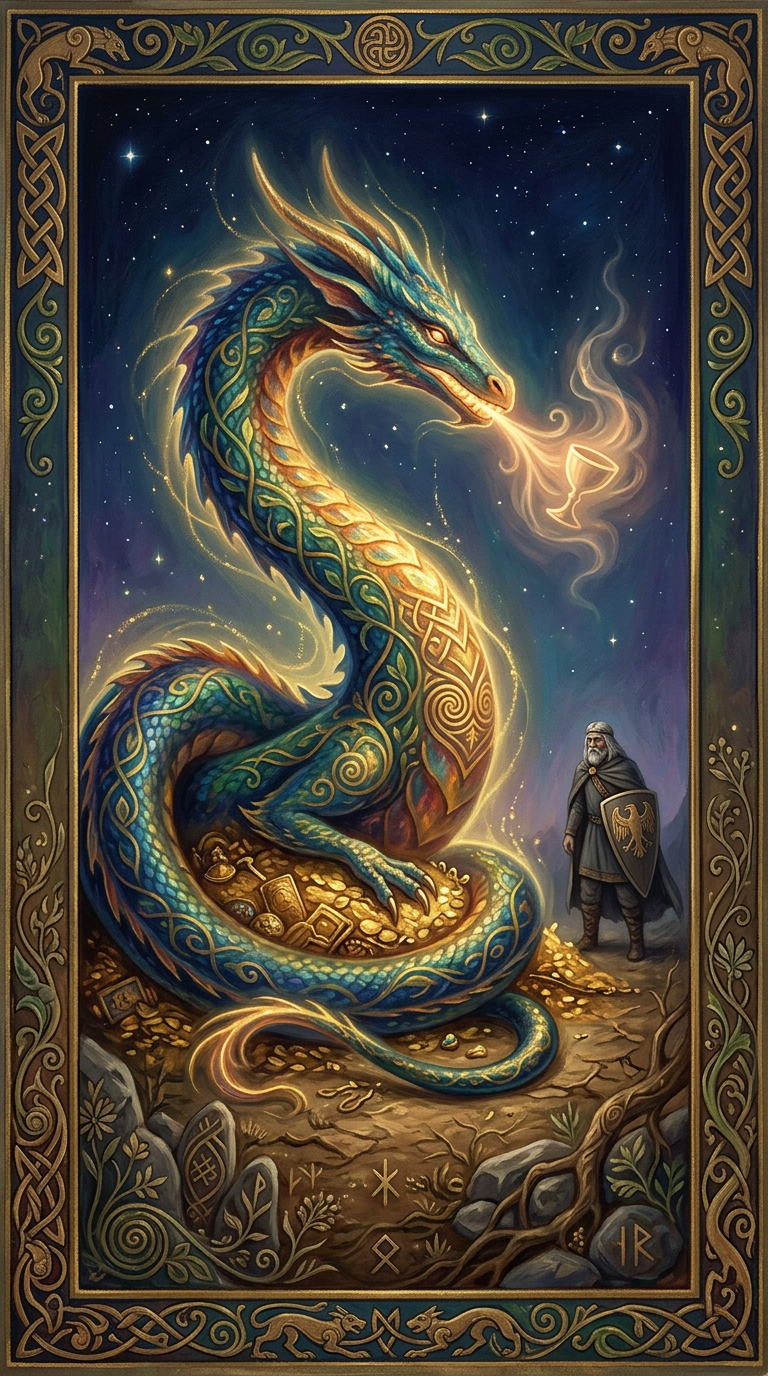
For three hundred years the dragon slept on a buried hoard — the grave-gold of a vanished people — until a fugitive stole one cup. For one cup, it burned the countryside. Beowulf, now an old king, goes to meet it knowing the price; his warriors flee, save young Wiglaf; king and dragon kill each other, and the poem ends in funeral smoke. The old English elegy is unsparing: hoarded wealth breeds a guardian of exactly its own size, wakes at the smallest theft, and the reckoning falls on the whole land — paid, in the end, by the best.
Beowulf's dragon arrives in the last third of the Old English poem, some fifty years after Grendel and Grendel's mother, and it is a different order of adversary. Grendel is an outsider who resents the hall's joy. The dragon is not personal at all. It is the logic of a hoard given scales: an accumulation of gold that no longer belongs to anyone living, guarded by a creature whose whole existence is the refusal to let it circulate. The poet calls the treasure useless to men even before the burning starts, and buries it again at the end.
The theft that wakes it is almost nothing — one cup, taken by a runaway slave in a moment of fear. That disproportion is the point. A hoard is a system holding its breath; anything that touches it releases everything. The fire falls on farms and the king's own hall, not on the thief.
What the poem then does with Beowulf is the true elegy. He is old and he goes anyway, and he goes with the wrong instinct: alone, for glory, when eleven armed men stand behind him. Ten of them run. Wiglaf, the youngest, does not, and the dragon is killed by two — but Beowulf dies of the bite and the Geats are left leaderless, awaiting the war that the messenger already predicts. The dragon's real victory is posthumous.
In the Shadow · Gift · Essence reading, Beowulf's dragon is the pure shadow-form of the serpent — the life-force that has stopped moving. Anything held out of circulation long enough grows a guardian exactly its own size, and the guardian eventually costs more than the gold.
The Great Correspondence
The Night WatchNüwa & Fuxi, serpent-bodied, gave humanity the 64 trigrams. The 64 descends from a serpent's hand. Here are this serpent's threads in the lattice.
«The Wall is the barrow's boundary: behind it sleeps the hoard-keeper, and the mansion tallies the price of every buried thing.»
The SGE Reading
Shadow deferred compounds: what a community buries and forgets sets the terms of a battle its finest must someday fight.
Canon Resonance
The generational teaching of the series: unworked shadow is an inheritance, and someone always pays the arrears.
A Micro-Practice
Name one 'buried hoard' in your family or team. Open one cup's worth of it deliberately, before it opens itself.
Sources & Respect
Beowulf (Old English epic), final movement.