A Moura-Serpe
The enchanted maiden who is half woman, half serpent, waiting beside a Galician spring for the traveler brave enough to greet her without turning away.
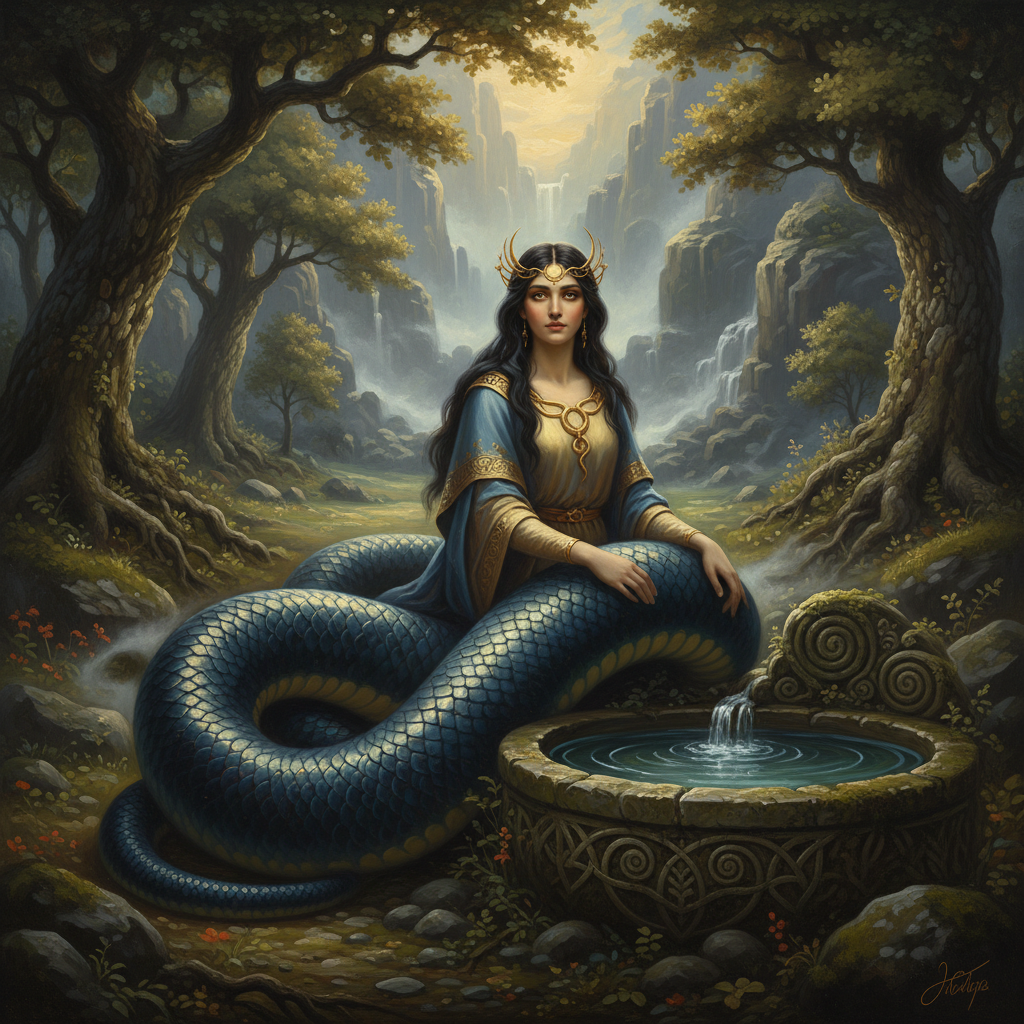
In the granite hills of Galicia, beside springs and mouths of old wells, folk tales speak of the Moura — a beautiful woman combing her hair in the sun, whose lower body is a coiled serpent. She is not evil. She is enchanted, bound to that place, waiting. She asks the passer-by for a single act: to greet her, to accept a fruit from her hand, sometimes to kiss her. Do this without fear and she is released — the spring becomes a place of blessing, sometimes of hidden treasure. Turn away and she remains, and the water remembers.
The Moura-Serpe is Galicia's way of saying something Nine Paths says in its own idiom: what has been rejected is not evil; it is enchanted. It is waiting for a form of attention it has not yet received. The serpent half is not the punishment; the serpent half is the language of the wait. What frightens the traveler is not the woman and not the snake — it is the seam between them.
To meet the Moura is to be met at the water's edge by a part of your own life that has been sleeping under stone. The kiss is not romantic; it is recognition. The treasure is not gold; it is the returned wholeness of a self you had exiled.
The SGE Reading
Shadow: the part of you that has been split at the waist — beautiful above, «unspeakable» below — waiting at the water for permission to be one thing.
Gift: the courage to greet what waits without demanding it change its shape first.
Essence: wholeness as a small daily kiss offered to the exiled half of your own life.
Canon Resonance
A Moura-Serpe belongs to the Path of the Bridge — the second of the Nine Paths, where two halves that had lived apart begin to remember they share a spine.
A Micro-Practice
A small greeting for an exiled part.
1. Bring to mind one part of yourself you have called «too much» or «too little». 2. Picture it seated by water, waiting, calm. 3. Do not try to change its shape. Simply say, silently: I see you. You may stay. 4. Notice what softens in the chest — small, almost nothing. 5. Return to your day carrying the promise: I will pass this way again.
Sources & Respect
Risco, *Historia de Galicia — mitoloxía* (1928). Cuba, Reigosa & Miranda, *Diccionario dos seres míticos galegos* (1998). Field notes gathered around A Coruña, Ourense and Pontevedra parishes.
The Moura is a folkloric figure, not a religious deity — but she belongs to a landscape people still live in. Do not extract her from Galicia; visit her there.