Two Dragons Under the Tower
Dinas Emrys and the politics of unintegrated shadow.
By Prof. Luis Miguel Gallardo··5 min read
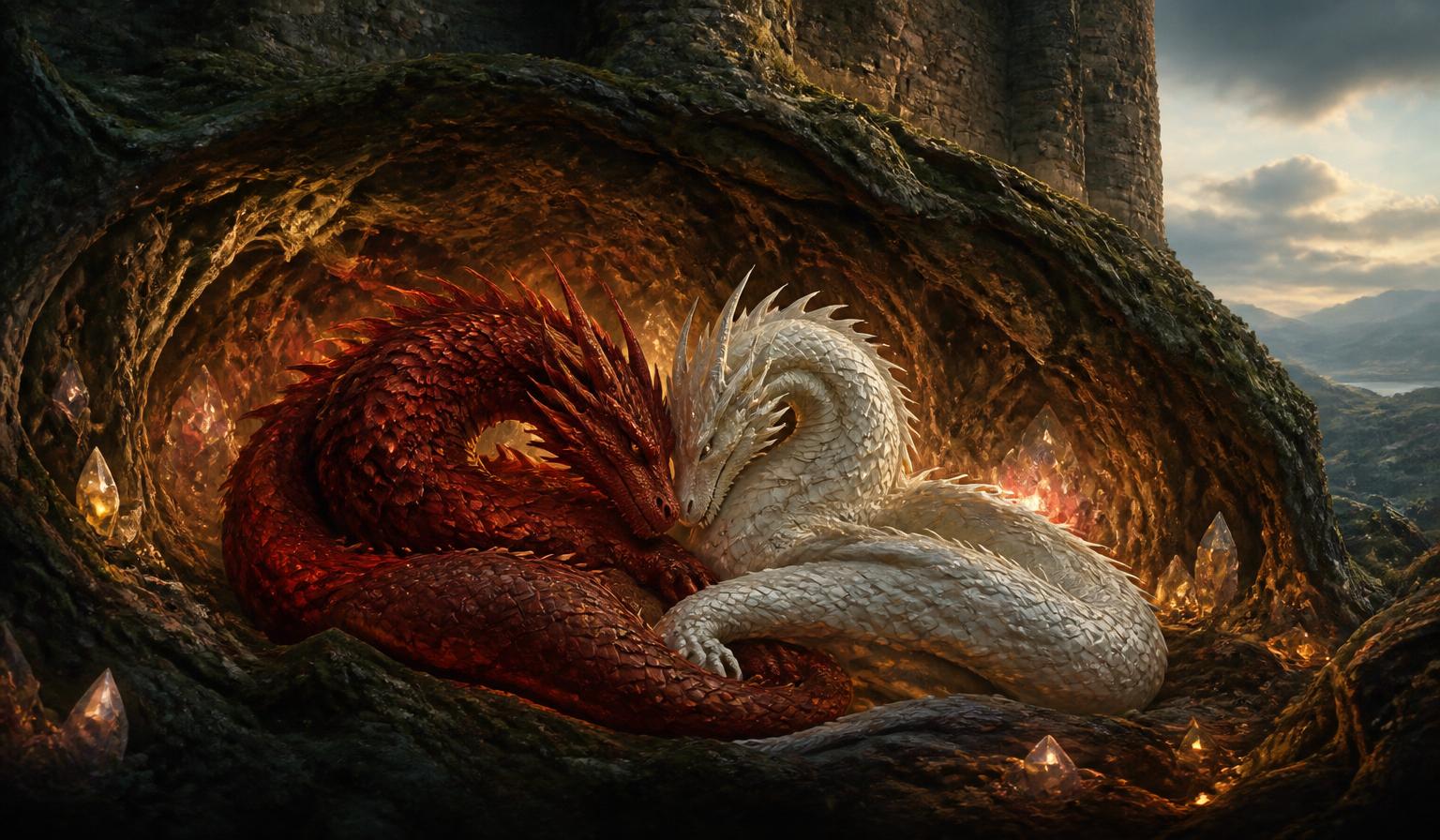
In the mountains of Snowdonia, in north Wales, there is a wooded hill called Dinas Emrys, and on it the scattered stones of something that kept refusing to exist.
The story is among the oldest in British legend. Vortigern, a king with much to fear --- he had, the chronicles imply, betrayed his own people to their invaders, and was now fleeing the consequences --- chose this hill as the site of an impregnable tower. His builders built. In the morning, the walls lay collapsed. They built again; again the ruin. Whatever was raised by day was swallowed by night. The king's wise men, consulted, produced the kind of answer desperate power always produces: find a boy with no father, they said, and sprinkle his blood on the foundations. The sacrifice will hold the stones.
The boy they found --- Emrys, whom later tellings would call Merlin, this his first appearance in the world's imagination --- saved his own life with a question no one had thought to ask: do you actually know what is under the hill? Dig, he told them. They dug, and found beneath the foundations a hidden pool; and in the pool, when it was drained, two dragons sleeping, one red and one white --- who woke, and fought, as the boy explained they had been fighting all along, every night, beneath every collapse. The tower had never had an engineering problem. It had a basement problem. No structure, however well built, stands on top of an unresolved war.
Read once, it is a marvelous tale with a marvelous career --- the red dragon went on to the Welsh flag, where it flies to this day. Read closely, it is the most precise diagnostic parable ever composed, and its precision begins with what the story refuses to let the king do.
It refuses, first, the engineering response. Vortigern's instinct --- our instinct --- when a project keeps collapsing is to improve the construction: better architects, stronger stone, longer hours. The legend is merciless on this point: the daytime work was never the problem. You may perfect the visible structure indefinitely; if the foundation contains a live conflict, the nights will keep undoing the days. Anyone who has rebuilt the same relationship pattern with a new person, relaunched the same failing initiative under a new name, or made the same resolution every January knows exactly which tower this is.
It refuses, second --- and this is the story's dark glory --- the sacrificial response. When engineering fails, power reaches for a scapegoat: some marginal person whose blood, poured on the problem, will make it hold. The wise men's advice is not an antique grotesquerie; it is a permanent temptation with modern clothes. Blame the junior employee for the structural failure. Blame the minority for the nation's subsidence. Sacrifice a symptom-bearer and pour them on the foundations. The legend's judgment is unambiguous: the sacrifice would have changed nothing, because the dragons would still be there --- and it took a child marked for scapegoating to say so, which is its own lesson about where clear sight tends to live.
What the boy prescribes instead is the only thing that ever works, and the story states it with the economy of myth: drain the pool. Make the hidden water visible. The dragons cannot be addressed --- cannot even be accurately named --- while they fight in the dark beneath the floor. Diagnosis precedes everything; the conflict must be brought up into the light where it can be seen as what it is: not mysterious nightly ruin, but two specific, nameable forces locked in a specific struggle. In the language of depth psychology, the move is exact: the unconscious conflict, invisible, expresses itself as symptom --- the collapsing tower --- until it is made conscious, at which point it becomes something that can actually be engaged. The legend even honors the humbling scale of the discovery: the dragons, once revealed, are far bigger than the tower. They always are. The presenting problem is never the size of the real one.
And notice what the boy does not prescribe: he does not kill the dragons. In the old Welsh telling the pair had been buried at the island's center generations before, as a protection --- powers laid down, not destroyed, and then forgotten by the very people they guarded. Their war under the hill is the war of the unremembered. Once drained into daylight, the red and white dragons fight in the open, the boy reads their battle as prophecy --- the struggle, he tells the king, is the struggle of peoples, and it will run its long historical course --- and the tower question simply dissolves: Vortigern abandons the site, and on that hill, tradition says, a fortress could finally be built, by another and better man. The teaching is delicate and easy to miss. Conflicts of foundation are not always yours to resolve on your schedule; some are larger than your project and older than your arrival. But they are always yours to know. Build in ignorance of them and the nights will eat your work; build in knowledge of them, and even the great unresolved wars can be built beside, respected like weather, on ground honestly surveyed.
England's northern legends kept the appendix to the Welsh diagnosis. The Lambton Worm --- the monstrous serpent that terrorized a valley for years --- began as a small strange thing a young lord fished up on a Sunday and, not liking the look of it, tossed down a well. Out of sight; problem solved. In the well, unwatched, it grew to fit the darkness, and emerged the size of the damage it would do. The two stories are one curriculum. The worm in the well is how the dragons get under the tower: everything discarded rather than dealt with descends into the foundations and continues growing at the rate of its neglect. The nightly collapse is simply the mortgage payment, come due, on every "later" we ever said to something alive.
The hill is still there, above the Glaslyn. The red dragon still flies over Wales --- a nation that took as its emblem not the tower, note, but the dragon from under it: the buried thing raised up, acknowledged, made the very sign of the people. That is one available ending, and the best one. The other is Vortigern's: to keep building, keep collapsing, keep consulting advisers who suggest fresh blood for the foundations, and never once ask the boy's question.
So ask it --- of the project that keeps failing identically, the relationship that ruins itself on schedule, the institution that reorganizes annually and changes nothing, the nation whose towers will not stand: what is under the hill? Then send for no architects and select no scapegoats. Send for shovels.
The pool drains. The dragons surface. And the work --- the real work, the work that was always waiting underneath the work --- finally begins on solid ground.
The Inner Circle keeps a practice companion for every station — Join.