The Tigress and the Dragon
Tiger's Nest, Guru Rinpoche, and the art of binding demons as protectors.
By Prof. Luis Miguel Gallardo··5 min read
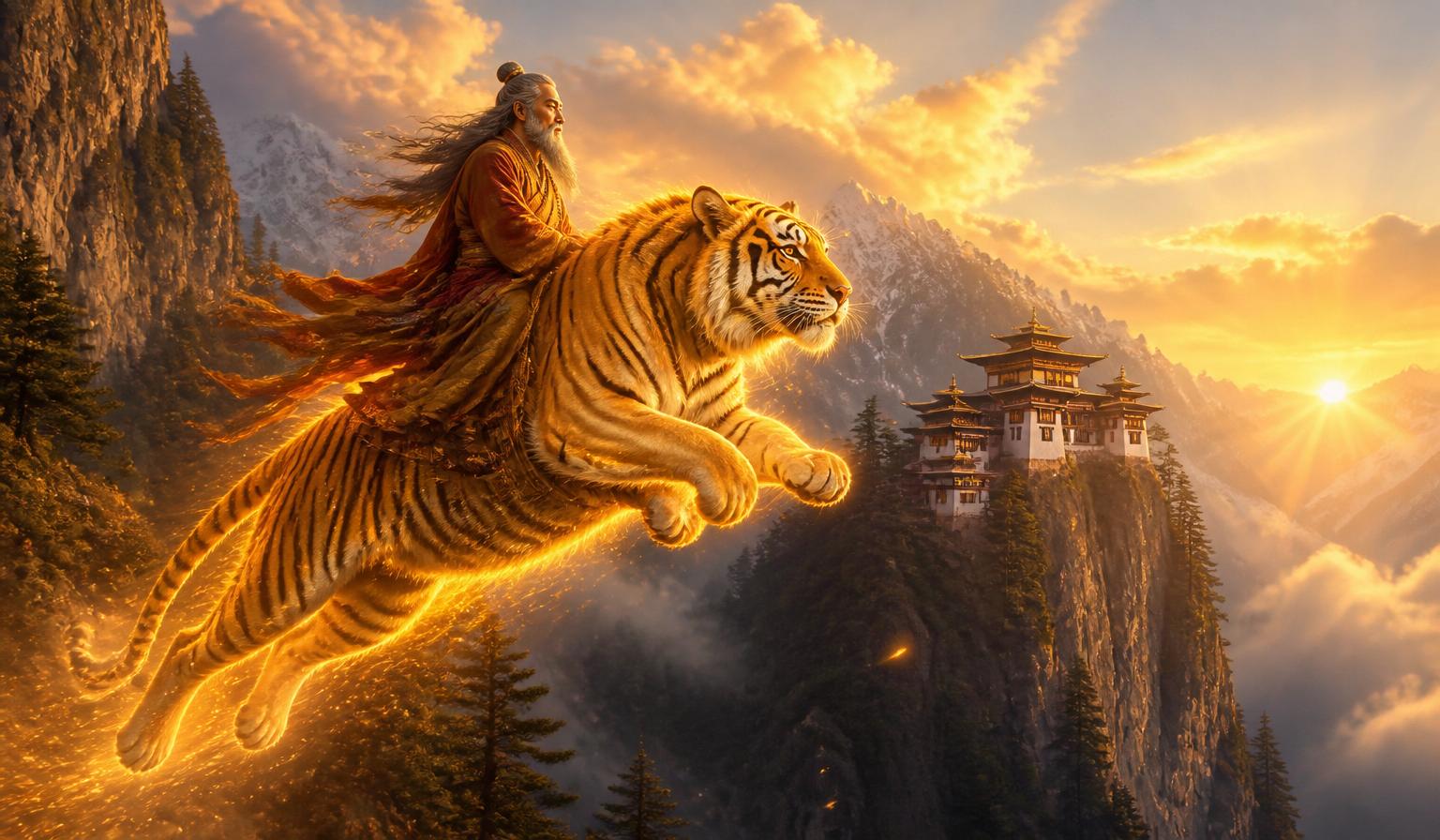
There are buildings that argue with gravity, and then there is Paro Taktsang. The monastery the world calls the Tiger's Nest does not sit on its mountain; it adheres to it --- white walls and golden roofs pressed flat against a granite cliff nine hundred meters above the floor of the Paro valley, in western Bhutan, looking less constructed than landed, as if it had flown there. Which, according to the story it commemorates, is precisely what happened.
In the eighth century, the tantric master Padmasambhava --- Guru Rinpoche, "the Precious Teacher," the figure Himalayan Buddhism reveres as a second Buddha --- came to this cliff flying on the back of a tigress. And the tradition adds the detail that changes everything about how the image should be read: the tigress was no mere mount. She was Yeshe Tsogyal, his consort and greatest disciple --- herself one of the towering realized masters of the age --- in transformed shape. The wisdom-woman as the wisdom-vehicle: the feminine not carried by the journey but carrying it, her wildness not tamed out of her but become the very means of arrival at the unreachable place. He meditated in the caves that the monastery now enshrines. And then he did the thing he had come to do, the thing he did all across Tibet and Bhutan, the thing that makes him --- beyond theology, beyond legend --- one of the great psychologists in human history.
He met the local demons. And he did not kill them.
Understand what the moment looked like from inside the old cosmology. The Himalayan world Padmasambhava entered was thick with spirits --- gods of mountains, serpent-beings of the springs and soil (the lu, cousins of India's nagas), wrathful powers of pass and gorge and storm, many of them hostile to the new teaching, some of them, the chronicles say, actively wrecking every attempt to build. The template available to him was the oldest one in the world: the hero arrives, the monster resists, the hero slays. Every culture keeps a version. Marduk splits the sea-dragon Tiamat and builds the world from her corpse. Saint George pins the serpent and the kingdom converts by dinnertime. Apollo kills the Python and takes the shrine. The pattern is so universal we barely notice it is a choice.
Padmasambhava chose otherwise, systematically, as a method. Encountering each hostile power, he did not destroy it; he outshone it --- met its fury from a stability it could not disturb --- and then, at the moment of its submission, did the unprecedented thing: he bound it by oath and gave it a job. The demon of the pass became the sworn protector of travelers on the pass. The wrathful goddess of the mountain became the guardian of the teachings in that valley. The serpent-spirits of the soil kept their springs, their dignity, and their offerings --- and undertook, in exchange, to protect the dharma and those who practice it. The Himalayan pantheon is full of these beings to this day: the dharmapālas, the oath-bound protectors, still depicted with their fangs and flames and garlands of skulls --- nothing about their fierceness edited away --- but facing outward now, their ferocity enrolled in the defense of exactly what they once attacked. Walk into almost any temple in Bhutan or Tibet and they are there at the door: the monsters, on staff.
Set the two templates side by side and the stakes become vivid. Saint George leaves a dead dragon and an unguarded kingdom --- and the shadow, being energy rather than creature, does not actually die; the killed monster returns, in the endless sequels every slaying spawns, because ferocity expelled is ferocity relocated. Guru Rinpoche leaves living demons under oath --- their power intact, conserved, redirected --- and a civilization that has been continuously guarded by its converted shadows for over a millennium. One method produces heroes and recurrences. The other produces protectors and peace. It is the difference between amputation and integration, prosecuted at the scale of a whole religious landscape; the Tibetan phrase for what the master did to the spirits --- taming, subduing to the good --- names the most sophisticated shadow-doctrine ever institutionalized. Modern psychotherapy, thirteen centuries later, would arrive by its own route at the same clinical finding: the exiled parts of the psyche do not need execution, they need employment; the rage that terrorizes an unlived life becomes, met and sworn in, the fierceness that defends its boundaries; every demon is a guardian who has not yet been given the job.
The land around Taktsang keeps the whole curriculum in view. Beneath its fields and springs live the lu, the serpent-spirits farmers still propitiate before breaking ground --- the etiquette of the bound powers, honored in daily practice. Hidden in its rocks and lakes and minds, the tradition holds, lie the termas, the treasure-teachings Guru Rinpoche and Yeshe Tsogyal concealed for future generations --- guarded, of course, by precisely the kinds of beings he swore to the task. And flying over all of it, on the prayer flags that stitch every ridge of Bhutan, ride the Four Dignities of the awakened warrior: the tiger of grounded confidence, the snow lion of disciplined joy, the garuda of fearless freedom --- and the dragon, the fourth and final dignity, whose quality the tradition names with a word that should be impossible: gentle power. The dragon of the Four Dignities does not display. It does not need to. It speaks rarely, and when it speaks it is thunder --- the voice of truth that wakes a whole valley at once and is always followed by rain. The tigress carries the master to the cliff; the dragon is what the path produces: power so fully integrated it has become weather.
That is the secret hiding in the monastery's name. Tiger's Nest --- but the nest of a tiger is where something is hatched. The cliff where the wisdom-tigress landed became the incubator of a civilization's entire relationship to its own dark energies: not exile, not slaughter, but oath and office. Bhutan, the Thunder Dragon Kingdom, the country that would one day astonish the world by measuring its progress in happiness, was seeded at a cave where the founding act was the conversion of enemies into guardians. Nations, like people, are built on their first metabolized shadow.
And the instruction travels. Whatever is wrecking the building site of your life --- the fury, the fear, the hunger, the grief with fangs --- the cliff at Paro suggests a protocol older and stranger than war: climb to where it lives, on the back of everything wild in you that you have not disowned; meet it from the stillness it cannot shake; and when it yields, do not reach for the sword. Reach for the contract. Ask it what it has been protecting all along, and then --- with full honors, fangs and flames intact --- give it the job it was born for.
The monsters make magnificent staff. The Himalayas have a thousand years of references.
The Inner Circle keeps a practice companion for every station — Join.