The Sword Inside the Dragon
Orochi, Fáfnir, and where the gift is actually hidden.
By Prof. Luis Miguel Gallardo··5 min read
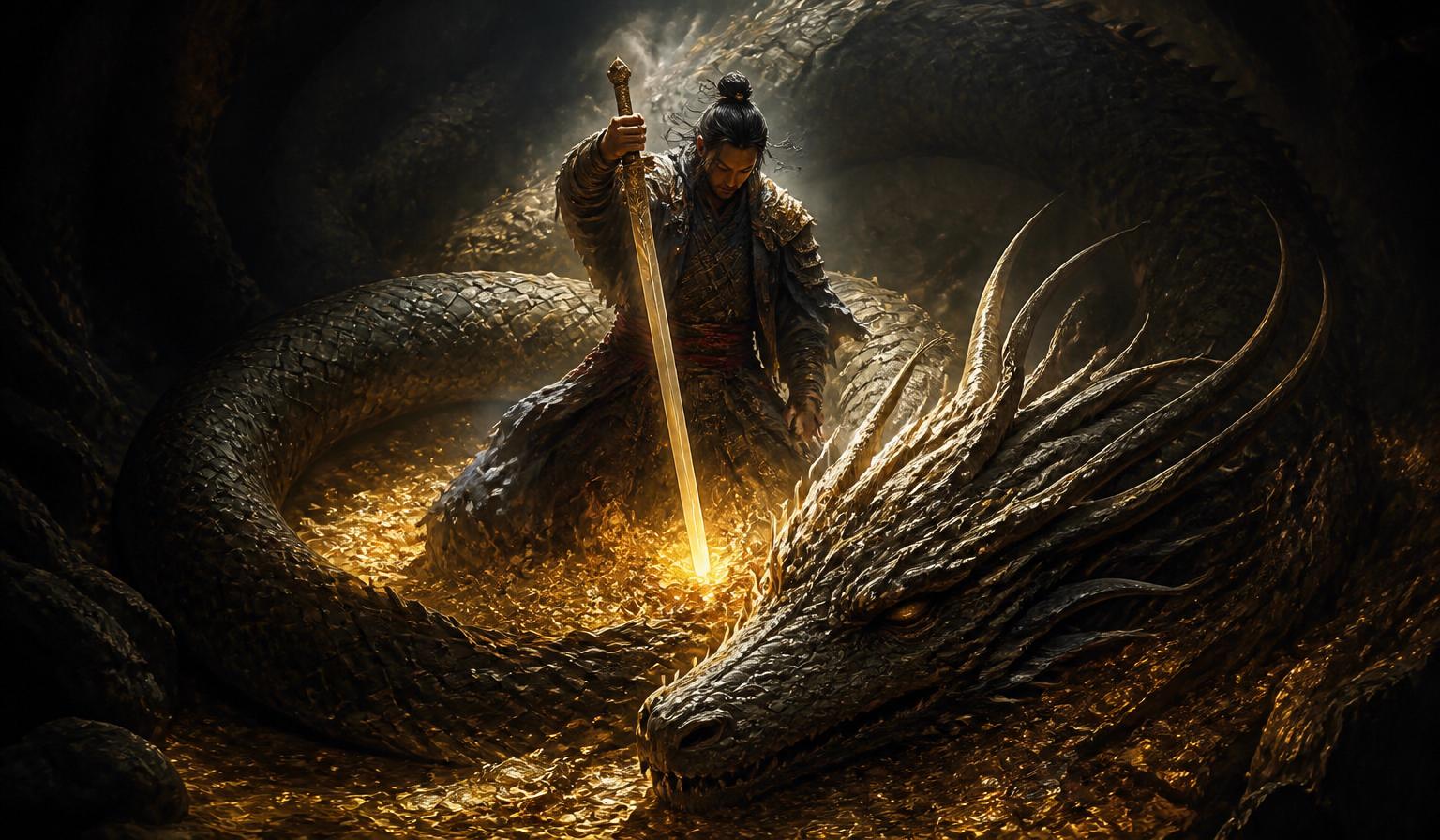
Japan keeps three treasures. They are the imperial regalia --- mirror, jewel, and sword --- and the sword, Kusanagi, has a birthplace unlike any other royal weapon on Earth. It was not forged for a king. It was found: inside the body of a monster.
The story stands near the beginning of Japanese myth. The storm god Susanoo, exiled from heaven, comes upon an old couple weeping beside a river: a serpent with eight heads and eight tails --- Yamata no Orochi, vast enough that pines grow on its back and its body fills eight valleys --- has devoured seven of their daughters, and is coming for the eighth. Susanoo does what heroes do: he prepares eight vats of strong sake, one for each head; the serpent drinks, sleeps, and is cut to pieces. So far, the oldest plot in the world. But then the story does the thing that lifts it out of the ordinary forever. As Susanoo's blade works through one of the tails, it strikes something it cannot cut. He opens the flesh --- and draws out a sword, flawless, already perfect, as if it had been waiting there since before the monster was a monster. That blade became one of the three sacred treasures of Japan, token of imperial legitimacy itself. The realm's deepest emblem of rightful power was not made by any smith. It was extracted from inside the dragon.
Hold that image against its northern cousin. In the Norse Völsung cycle, the hero Sigurd slays Fáfnir --- the dwarf whom greed for cursed gold had literally transformed into a dragon --- and then, roasting the dragon's heart at his treacherous foster-father's request, burns his thumb on the sizzling flesh and puts it to his mouth. One taste of the dragon's blood, and the world changes register: Sigurd suddenly understands the speech of birds --- who immediately warn him of the betrayal being prepared, and tell him where his path lies. Note what the treasure is here. Not the gold; the gold is cursed and ruins everyone it touches, as hoards do. The true prize Fáfnir yields is perception: taste the dragon --- take its substance into your own body --- and you receive its senses. You begin to hear what the world has been saying all along.
And India, characteristically, tells the same secret at the scale of the cosmos. In the churning of the ocean of milk, gods and titans wrap the serpent-king Vasuki around the world-mountain and pull, alternating, for an age --- churning existence itself in search of amrita, the nectar of immortality. The serpent is the rope of the whole operation: no serpent, no churning; transformation itself has a serpent's body. But before the nectar rises, something else does --- halāhala, a poison so total it threatens all the worlds. The work stalls at the edge of catastrophe until Shiva, the great ascetic, does what no one else can: he drinks the poison and holds it in his throat, which turns forever blue. Only then, with the poison metabolized by consciousness, does the ocean yield its wonders, and at last the nectar. The sequence is not decoration; it is doctrine, stated with Indian exactness: poison precedes nectar, always, and the poison must be neither swallowed into the depths nor spat back into the world, but held --- at the throat, at the place of expression --- transmuted by a presence vast enough to hold it. Shiva wears the serpent coiled at that same throat forever after: the integrated poison, worn as an ornament.
Three traditions, three climates, one map with one address on it. The sword is in the tail. The new perception is in the blood. The nectar is under the poison. Never beside. Never adjacent, available by a clever detour, purchasable at a stall next to the monster. Inside. The mythologies of the world are unanimous on the geography, and the unanimity matters because it contradicts, precisely, the geography we all prefer. Faced with the dragon-shaped things in a life --- the grief, the rage, the addiction, the shame, the fear that fills eight valleys --- our instinct is lateral: go around, build elsewhere, seek the treasure in some sunlit territory unconnected to the dark one. Entire industries of self-improvement are built on the promise of the side entrance. The myths, older and kinder, keep repeating that there is no side entrance. What you need next is located, with malicious precision, inside what you least want to open.
Why should this be? The stories themselves suggest the logic, if we read them closely. Fáfnir was not always a dragon; he was a person, transformed by what he clutched. The dragon, in other words, is not an alien intrusion but a formation --- energy of the person, contorted around something it once needed to protect or possess. And energy is conserved. The intensity that built the monster is the same intensity that, released, becomes the gift: the rage that guards the wound is the assertiveness the life has been missing; the hypervigilance that exhausts is perception waiting for a better assignment; the grief that fills eight valleys is the exact measure of a capacity to love. The sword was in the tail because the tail is where the serpent's force gathers. The blood conferred bird-speech because the dragon had spent an age listening. Nothing needs to be imported into the dragon for the treasure to be there. The treasure is the dragon's own substance, waiting for a different owner --- you, arrived at last, with a blade and the nerve to open what you killed or what almost killed you.
The Greeks appended the necessary warning, so the doctrine would not curdle into recklessness: the Hydra. Attack the shadow crudely --- hack at heads, symptom by symptom --- and it multiplies; two grow where one fell. The inside route is not a license for violence against oneself. It is the route of Shiva's throat and Sigurd's single deliberate taste: contact that is total but held, the poison met by a presence that does not flinch and does not gulp. In the vocabulary of emotional alchemy: name the shadow; anchor it in the body; and only then reach into it for the gift --- which was never anywhere else.
So the practice this old atlas leaves us is a change of address. Take the dragon-shaped thing you have been walking around --- the conversation, the memory, the feeling with eight heads. Stop circling. The stories have already surveyed the terrain and filed the report, identical from Kyoto to Iceland to the ocean of milk: what your next life requires is inside it, whole, flawless, and unreasonably patient --- a sword that was never damaged by its residence, waiting in the one place you swore you would never cut open.
Bring the nerve. The address has not changed in three thousand years.
The Inner Circle keeps a practice companion for every station — Join.