The Shadow That Descends the Pyramid
Chichén Itzá, the nine terraces, and why the equinox serpent is a map of consciousness.
By Prof. Luis Miguel Gallardo··5 min read
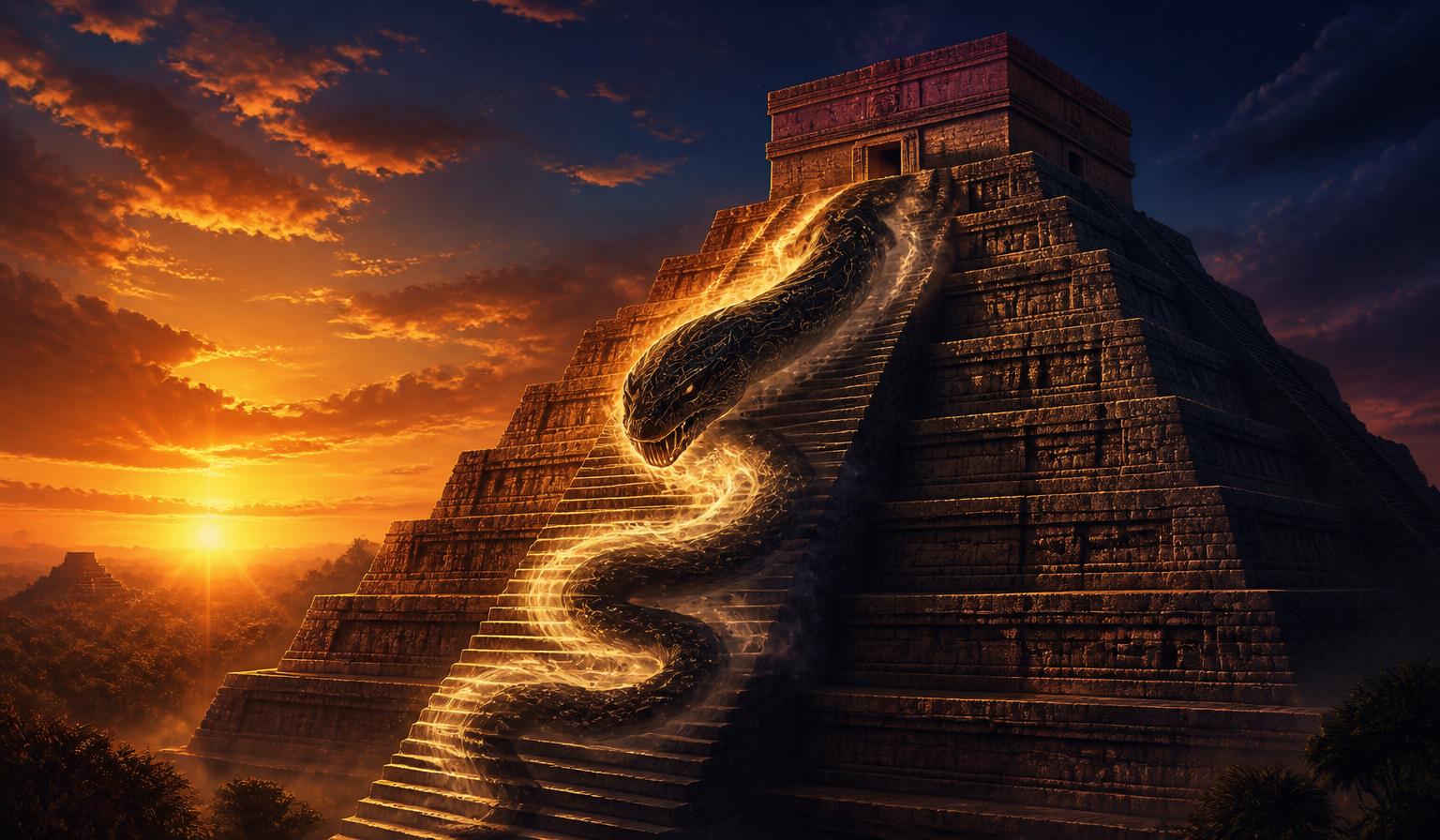
Every spring equinox, in the last hour before sunset, several thousand people gather on the great plaza of Chichén Itzá and turn their faces toward the northern staircase of El Castillo. They are waiting for a shadow.
At first there is nothing --- only the pyramid, patient as it has been for a thousand years. Then the lowering sun catches the nine terraced platforms of the western face, and their stepped edges begin to cast triangles of light onto the balustrade of the northern stair. One triangle. Then another below it. Then another, until seven isosceles diamonds of sunlight lie linked along the stone like the diamond-back pattern of a living snake --- and the whole luminous body appears to slide, slowly, down the pyramid, until it joins the great carved serpent head that has been waiting at the base since the tenth century.
The Maya called him K'uk'ulkan --- the Feathered Serpent, the being in whom the bird of heaven and the snake of earth are one body. Twice a year, on the days when light and darkness stand equal, he descends.
It is tempting to file this under astronomical curiosity: a brilliant piece of archaeo-engineering, proof that the Maya could choreograph the sun. And it is that. El Castillo is a calendar you can climb --- four staircases of ninety-one steps which, with the upper platform, count three hundred and sixty-five. But precision was never the point. Precision was the language. The point is what the building says with it, and what it says is a complete teaching about the nature of consciousness, written in a medium that cannot decay: geometry and light.
Consider, first, the direction. The serpent does not ascend. In almost every image our civilization holds of spiritual life, the sacred is up --- we climb toward it, aspire to it, transcend toward it. The pyramid says otherwise. The luminous serpent is born at the summit, yes, but its whole gesture is downward: heaven pouring itself into earth, light entering stone, spirit descending into matter and finding there --- not a fallen world, but its own other half, the carved head that completes it. The equinox event is a marriage. The Maya built a machine for displaying, twice a year, the moment when the vertical axis of the cosmos kisses the ground.
Consider, second, the number. The serpent's body of light is produced by the shadow of nine platforms. Nine is not decorative in the Maya world. The underworld, Xibalba, has nine tiers; nine Lords of the Night rule the hours of darkness in eternal rotation; the great funerary pyramids --- this one, and the Temple of the Inscriptions at Palenque, where King Pakal lies --- are built as nine stacked bodies of stone. Nine is the number of the deep: of gestation, of descent, of everything that ripens in darkness before it can be born. A human child takes nine moons. The serpent of light takes nine terraces. Whatever comes fully into the world, comes through nine.
And consider, third, the ingredients. The serpent is made of neither light nor shadow but of their alternation --- triangle of sun, edge of darkness, triangle of sun. Remove the shadow and there is no serpent, only glare. Remove the light and there is only the blind north face of a ruin. The most sacred image in the Maya world is manufactured, before your eyes, out of the cooperation of what we spend our lives trying to separate. Anyone who has done real inner work will recognize the recipe. What we call the shadow --- the feared, the exiled, the unlit portions of ourselves --- is not the enemy of our radiance. It is the other half of the pattern. Consciousness, like the serpent of Chichén Itzá, is not made of light. It is made of light articulated by darkness, each triangle of brilliance given its shape by the dark edge beside it.
This is why the descent of Kukulcán deserves to be read not as a spectacle but as a map --- perhaps the oldest publicly displayed map of the process the contemplative traditions describe from within. First, equilibrium: the event only occurs at equinox, when day and night are equal --- the inner work only begins when we stop favoring our light over our dark. Then, descent: attention leaves the summit of abstraction and travels down, level by level, through the nine layers of what we are, toward the body, the earth, the ancestral. Then, at the base, recognition: the moving light meets the ancient stone head --- and the two serpents, the one that travels and the one that has always been waiting, turn out to be one being.
The traditions of the world tell this same story in a hundred dialects. India calls the waiting serpent Kundalini, coiled and sleeping at the base of the spine until she is remembered. Galicia tells of the moura who lives as a serpent under the old stones until someone dares to greet her true form. Bhutan was founded on a vision of nine dragons rising from the ground into the sky. The pyramid tells it with nothing but architecture and an afternoon.
And twice a year, it still works. The crowd goes quiet at the same moment it has gone quiet for a thousand years --- the moment the last triangle touches the stone head and the serpent is whole. Something in several thousand nervous systems, most of them belonging to people who would not use a single word of this vocabulary, recognizes what it is seeing. That recognition is the real event. The sun merely provides the demonstration.
Perhaps that is the pyramid's final teaching, and the reason it was built to require an audience. The serpent of light descends whether or not anyone watches; stone and sun keep their appointment regardless. But a map only becomes a map when someone reads it. The Maya left the diagram of the great descent standing in the open, on the scale of a small mountain, angled to catch the eye of every generation --- as if they knew that one day we would forget the journey and need to be shown, in a language older than language, that the way to the sacred runs downward, through our own nine levels, to the place where something with ancient eyes has been waiting all along for the light of our attention to arrive.
It is waiting still. The equinox comes twice a year. So, if we let it, does the descent.
The Inner Circle keeps a practice companion for every station — Join.