The Serpent of the Spine
Kundalini, the caduceus, Ningishzida: one image across five millennia.
By Prof. Luis Miguel Gallardo··6 min read
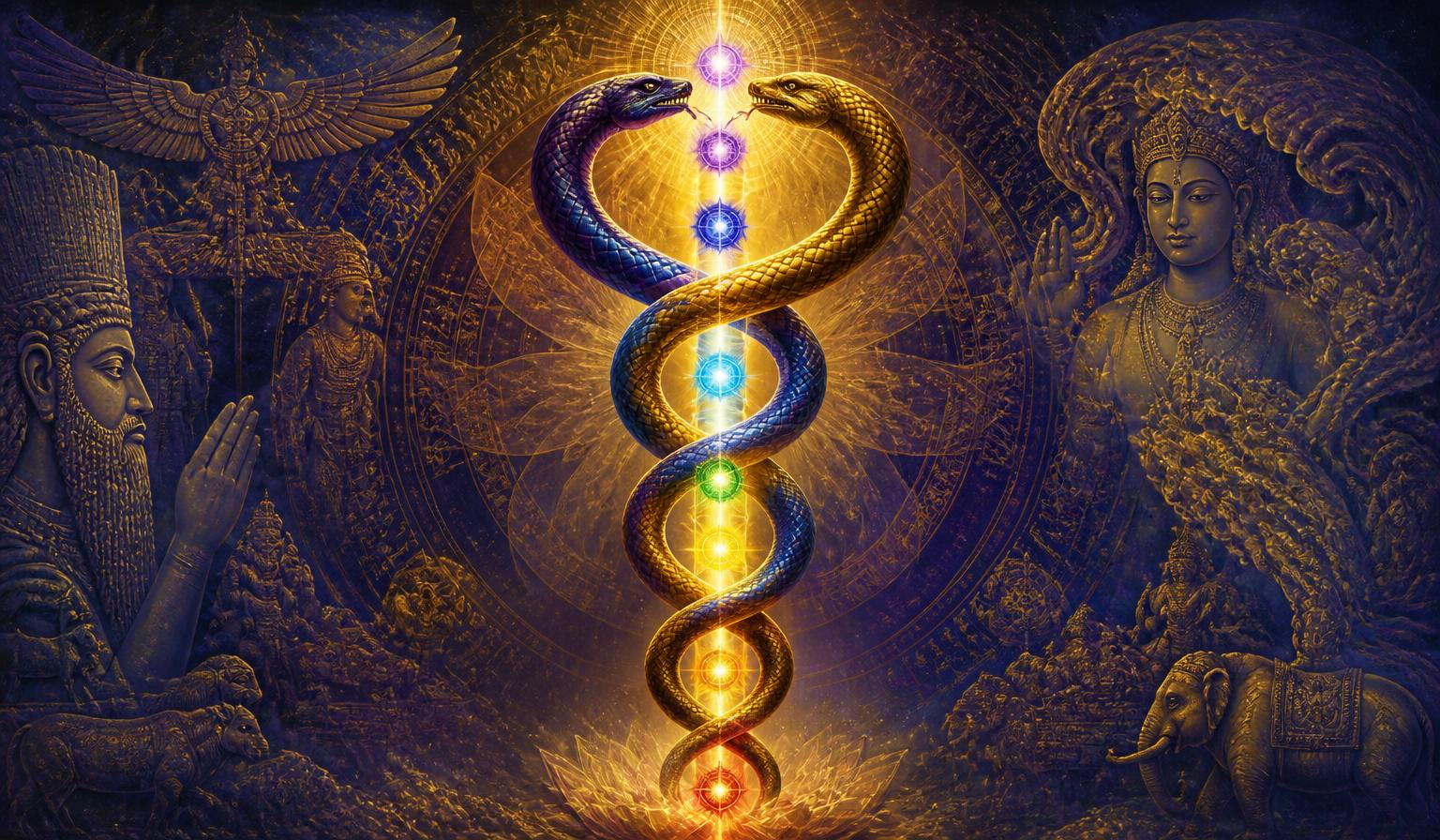
In the Louvre there is a green steatite vase, carved around 2100 BCE for Gudea, ruler of the Sumerian city of Lagash. It was made as an offering to Ningishzida --- "Lord of the Good Tree," a god of the underworld, of roots, and of healing --- and on its curved surface the artist engraved the god's emblem: two serpents, intertwined in symmetrical coils around a central staff. Look at it once and you cannot unsee the resonance; the image sits in the case like a message that arrived four thousand years early. It is, feature for feature, the drawing the Greeks would later place in the hand of Hermes as the caduceus; the drawing that --- through a long historical confusion with the single healing serpent of Asclepius --- winds today around the emblem of medicine on hospitals and ambulances across the earth; and the drawing that the yogis of India, working entirely from inner observation, made the master-diagram of the human energy body. Five thousand years, three continents, one picture: two currents, winding in opposite spirals around one axis, meeting and crossing as they climb.
It is worth pausing on how strange this is. Cultures separated by oceans and millennia disagreed about nearly everything --- gods, ethics, cosmology, the shape of the world. But hand them a stylus and ask them to draw the deep structure of life, of healing, of the sacred power in a human frame, and again and again the same figure appears. Either the coincidence is empty --- serpents are common, staffs are common --- or the traditions were all sketching the same observed thing. The yogic lineages of India would say, without hesitation, the latter: they were drawing from life. From inside.
Their account, refined across centuries of contemplative practice, goes like this. The human body carries, besides its visible anatomy, an energetic one: a central channel --- sushumna --- running the length of the spine, and around it two subtler currents, ida and pingala, the lunar and the solar, the cooling and the heating, spiraling upward in alternation, crossing at junctions the tradition maps as chakras: wheels, plexuses, gathering-points of aliveness. And at the base of the whole system, in the root center at the pelvic floor, the tradition places its most famous inhabitant: Kundalinī --- the coiled one. She is described with startling consistency across the old texts: a goddess, a power, the very energy of consciousness itself, lying coiled three and a half times around the root, asleep --- present in every human being from birth, mostly undisturbed for a lifetime, while the person above her runs on a fraction of the current their frame was built to carry.
The whole enterprise of yoga --- the postures, the breathing, the locks and mantras and meditations that the modern world has adopted as fitness --- was engineered, in its original intent, as a courtship of this sleeping serpent: purify the channels, balance the solar and lunar currents, still the mind, and then, gently or suddenly, by discipline or by grace, she wakes. What the texts describe next is the ascent: the serpent-power rising up the central axis, station by station, chakra by chakra --- each awakening its own transformations of perception, emotion, and knowing --- until she reaches the crown and unites with pure consciousness, and the separate self dissolves into what it always was. The marriage of Shiva and Shakti, celebrated at the top of your own spine.
Whatever one's metaphysics, notice what this map does that our modern maps do not. It locates the sacred in the body --- at the bottom of the body, in fact, in the pelvis, the root, the earthiest ground of us, precisely the region our inherited moralities taught us to fear or ignore. It insists that the highest human possibility is not an acquisition but an awakening of something already installed: the full current, sleeping in every person without exception, from birth. And it warns --- the tradition is emphatic on this --- that the waking is not a party trick. Kundalinī roused abruptly, in an unprepared system, is described in the old texts and in modern accounts alike as overwhelming: energy without banks, light without ground. Hence the entire apparatus of preparation, the insistence on teachers, ethics, patience, the strengthening of the vessel before the increase of the voltage. (A practical note belongs here, undecorated: contemplative traditions and contemporary clinicians agree that this territory rewards gradualness, grounding, and experienced guidance. The serpent has waited your whole life; she does not require hurrying.)
Once you hold the yogic diagram, the world's other serpent-staffs snap into focus as fragments of the same anatomy. The single serpent of Asclepius, climbing its rough staff, is the healing aspect isolated: life-force restored along the axis --- which is why the sick slept in his temples and woke cured, healing delivered, note, in the sleeping state. The twin serpents of Hermes are the two currents in their dance --- and Hermes is the messenger, the crosser of boundaries, patron of the traffic between worlds, exactly the function the yogis assign the awakened channel. The bronze serpent raised on a pole by Moses in the wilderness healed all who looked upon it --- elevation of the serpent as the cure for the serpent's bite. Even Ningishzida, where the trail began, is a god of the underworld and of the tree: root-power and rising trunk, the serpent as the sap of the axis mundi. And the Feathered Serpent of Mesoamerica states the endpoint as a single hyphenated being: snake-become-bird, the ground-dweller with wings, matter that learned to fly without ceasing to be matter. Every one of these traditions, it seems, caught a different frame of the same film: the serpent at rest, the serpent rising, the serpent crowned.
Modern eyes, inevitably, notice one more twist in the old spiral: the two strands of the DNA double helix, winding about a common axis, carrying the coiled instructions of life in every cell. It would be too much to claim the ancients saw molecules. It is exactly enough to say that life appears to favor this shape --- the helix, the coil, the two-in-one climb --- at every scale at which it stores its power, and that the contemplatives, gazing inward with the patience of centuries, drew what was there to be drawn.
Which leaves the question the diagram has been asking for five thousand years, from the vase of Gudea to the door of every pharmacy: if this is the anatomy --- the axis, the two currents, the immense coiled voltage sleeping at the root --- then most of us are living in the attic of a house whose basement holds a sun. The traditions differ on technique and disagree on theology, but on the essential report they are unanimous, and it is the single most optimistic claim ever made about human beings: the power is already installed. Nothing needs to be added to you. The serpent of the spine is not a metaphor you must believe; she is a possibility you contain --- coiled three and a half times, patient beyond all deserving, listening downward through the floors of you for the footsteps of a life that has finally decided to come home.
Walk gently. But walk down.
The Inner Circle keeps a practice companion for every station — Join.