The Rainbow That Holds the World
Aido Hwedo, Damballah, the Rainbow Serpent: the benevolent serpent of the South.
By Prof. Luis Miguel Gallardo··6 min read
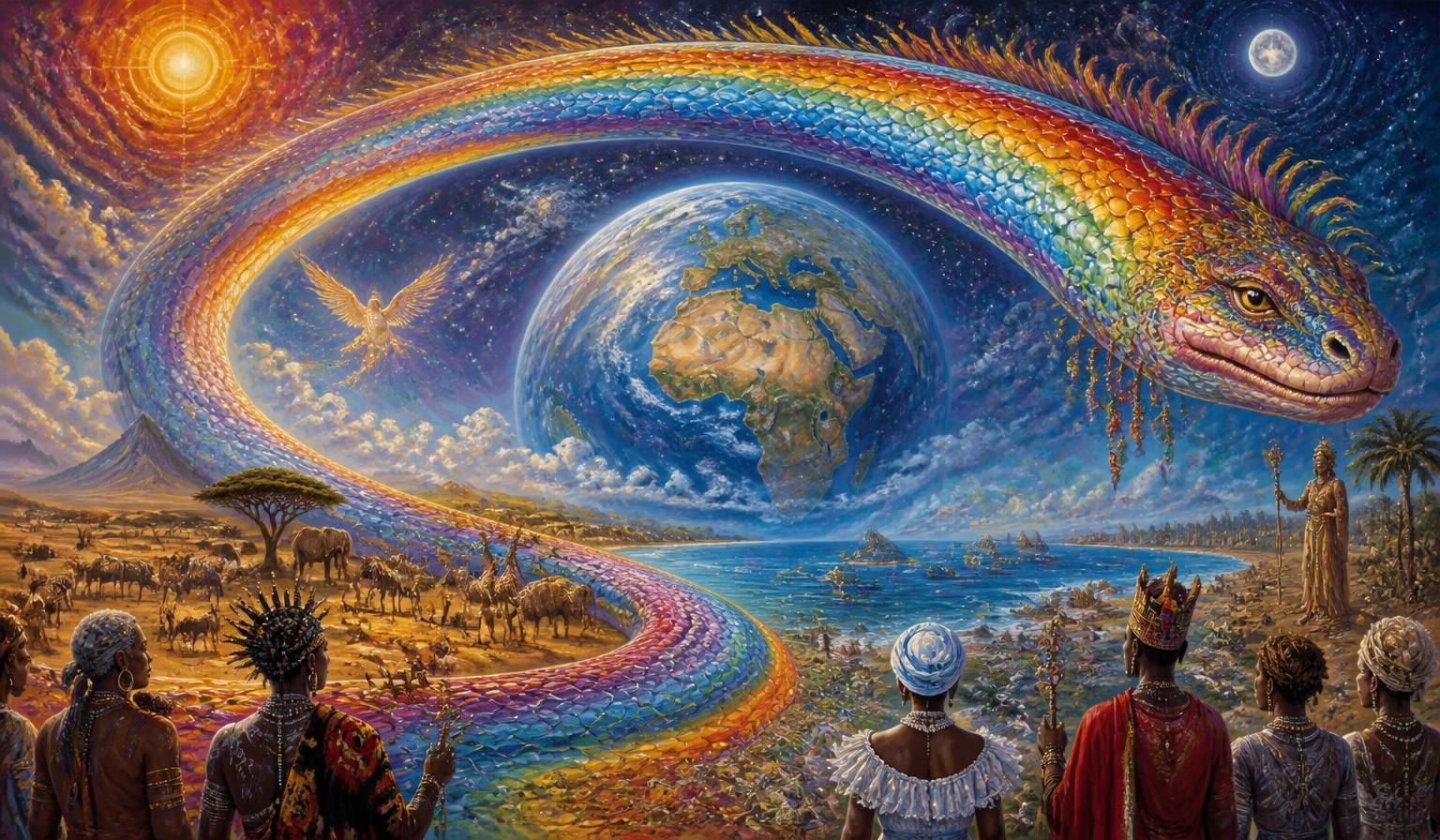
Every mythology must answer a child's question: what keeps the world from falling? The North tended to answer with architecture --- pillars, thrones, a tree, a giant holding up the sky by force. The South, across an astonishing span of unconnected traditions, answered with something warmer and stranger: a serpent, coiled beneath everything, holding the world together on purpose.
In the old kingdom of Dahomey, in what is now Benin, the Fon people tell of Aido Hwedo, the rainbow serpent who existed before the earth. When the creator Mawu set out to make the world, Aido Hwedo carried her in its mouth, and the landscape still bears the marks of that journey: where they rested, mountains rose; the winding of rivers is the memory of the serpent's passage. But the tenderest part of the story comes after creation. The finished world, Mawu saw, was too heavy --- overloaded with mountains, trees, elephants, people --- and would collapse. So Aido Hwedo coiled itself into a circle, tail in mouth, beneath the earth, and became its cushion and its clasp: the living ring on which everything rests. The tradition adds a detail of great practical wisdom: the serpent must be fed --- red iron, brought by monkeys of the sea --- because if Aido Hwedo ever grows too hungry, it will begin to swallow its own tail in earnest, and the world will slip. The cosmos, in this telling, is not a machine that runs itself. It is a relationship that must be maintained: the foundation is alive, generous, and has needs.
That serpent crossed the Atlantic in the worst ships in human history. In the holds of the Middle Passage, among peoples stripped of everything portable, the rainbow serpent traveled the only way it could --- in memory --- and surfaced in Haiti transfigured but unmistakable: Damballah Wedo, the great white serpent, most ancient and most venerable of the lwa of Vodou. Damballah is the closest thing the tradition has to primordial holiness: so old he precedes speech --- he does not talk in words but in whistles, in presence, in the sensation of cool water --- associated with purity, peace, creation, and the wisdom of beginnings, his devotees wearing white, his offerings the whitest things: an egg, flour, milk. And he is not alone. Arcing beside him is his wife, Ayida-Weddo, the rainbow serpent herself, and together they appear as the double rainbow: two serpents of light, the primal couple, holding between them --- as the rainbow holds --- the covenant that the storm is over and the world will continue. Think about what this means historically, and the theology becomes almost unbearably moving: people who had lost every possession, every place, every liberty, kept --- as their highest image of the divine --- not a warrior, not an avenger, but an ancient gentle serpent who holds the world together and asks for an egg. If mythology is a people's deepest weather report, this one says: beneath everything that was done to us, benevolence is still the foundation.
The mother of waters kept her serpent too. Along the coasts of West and Central Africa and throughout the Americas, Mami Wata --- radiant, sovereign, a great snake draped across her shoulders --- rules the wealth and danger of the deep: healer and tester, granter of fortune and demander of respect, the feminine sea with a serpent for a stole. And on the Zambezi, the Tonga people speak of Nyaminyami, the river-serpent separated from his wife when the Kariba Dam split their waters in the 1950s; the floods that repeatedly smashed the construction were understood as his grief and his protest. Nyaminyami is a living myth about the modern world: what happens when the serpent that holds a river's life together is cut in two by concrete --- and how a people keeps faith with the divided god, wearing his coiled image to this day.
And then there is the oldest of them all. Across Aboriginal Australia --- home to what may be humanity's longest continuous religious tradition --- the being that the outside world calls the Rainbow Serpent appears in rock art and ceremony reaching back thousands of years, known by many names in many nations: Ngalyod to the Kunwinjku of western Arnhem Land, the Wagyl to the Noongar of the southwest, and others, each belonging to its own country and law. The stories are not one story, and they are not ours to flatten; but with that respect stated, their shared shape can be honored: in the Dreaming, the great serpent moved through a soft and featureless land, and its body made the water places --- carving the rivers, deepening the gorges, coiling down into the permanent waterholes where it remains, guarding the water and the law. Here the serpent is not in the landscape, the landscape is the serpent's biography; the country itself is the track of its passage, and the deep pools are places where one does not simply barge in --- one is introduced, announced, brought properly by those who belong. It is the most complete identification of serpent and world anywhere in human tradition: the ground you stand on is not guarded by the serpent. It is the serpent, still present, still owed courtesy.
Set this hemisphere of serpents beside the one most of us inherited --- Apep the nightly enemy, the Hydra, the worm in its hoard, the dragon under the saint's spear --- and the contrast is almost embarrassing. It is not that the South's serpents are tame; every one of them can withhold, flood, test, and terrify. The difference is the default relationship. In the North's central stories, the serpent is a problem and the sacred act is violence. In the South's, the serpent is the foundation and the sacred act is maintenance: feed Aido Hwedo, offer Damballah his egg, respect Mami Wata's terms, approach the waterhole properly, keep the covenant. One hemisphere asks its people to be heroes. The other asks them to be good relatives.
Even the North's own scripture, read closely, keeps a rainbow-serpent memory of its own kind: after the flood, the sign of the covenant --- the promise that the waters will never again unmake the world --- is set in the clouds as a bow. The South would smile in recognition. Of course the sign of "the storm is over and the world will hold" is an arc of colored light spanning earth and heaven. They have known her name for a very long time.
What the rainbow serpents offer our moment, then, is not exotic decoration but a correction of posture. We are a civilization discovering, at scale and at cost, that the world does not run itself --- that soils, rivers, climates, and communities are not machinery but relationships, living foundations that fail when unfed. The Fon told us: the serpent under the world gets hungry. The Tonga told us: cut the river-god in half and the waters grieve. The oldest peoples of Australia have been saying it longest of all: the land is a being, and beings are owed courtesy. The dragon-slaying imagination is poorly equipped for this hour. The serpent-feeding one is its native expertise.
So perhaps the report from the Global South, carried through Middle Passages and across sixty thousand years of continuous ceremony, is the one to end on: the ground has been holding you your whole life, on purpose, out of something very like love. It is not asking for heroism.
It is asking for breakfast, and to be remembered.
The Inner Circle keeps a practice companion for every station — Join.