The Dragon in the Egg
Imugi, Orphic egg, Serpent Mound, and the intelligence of waiting.
By Prof. Luis Miguel Gallardo··5 min read
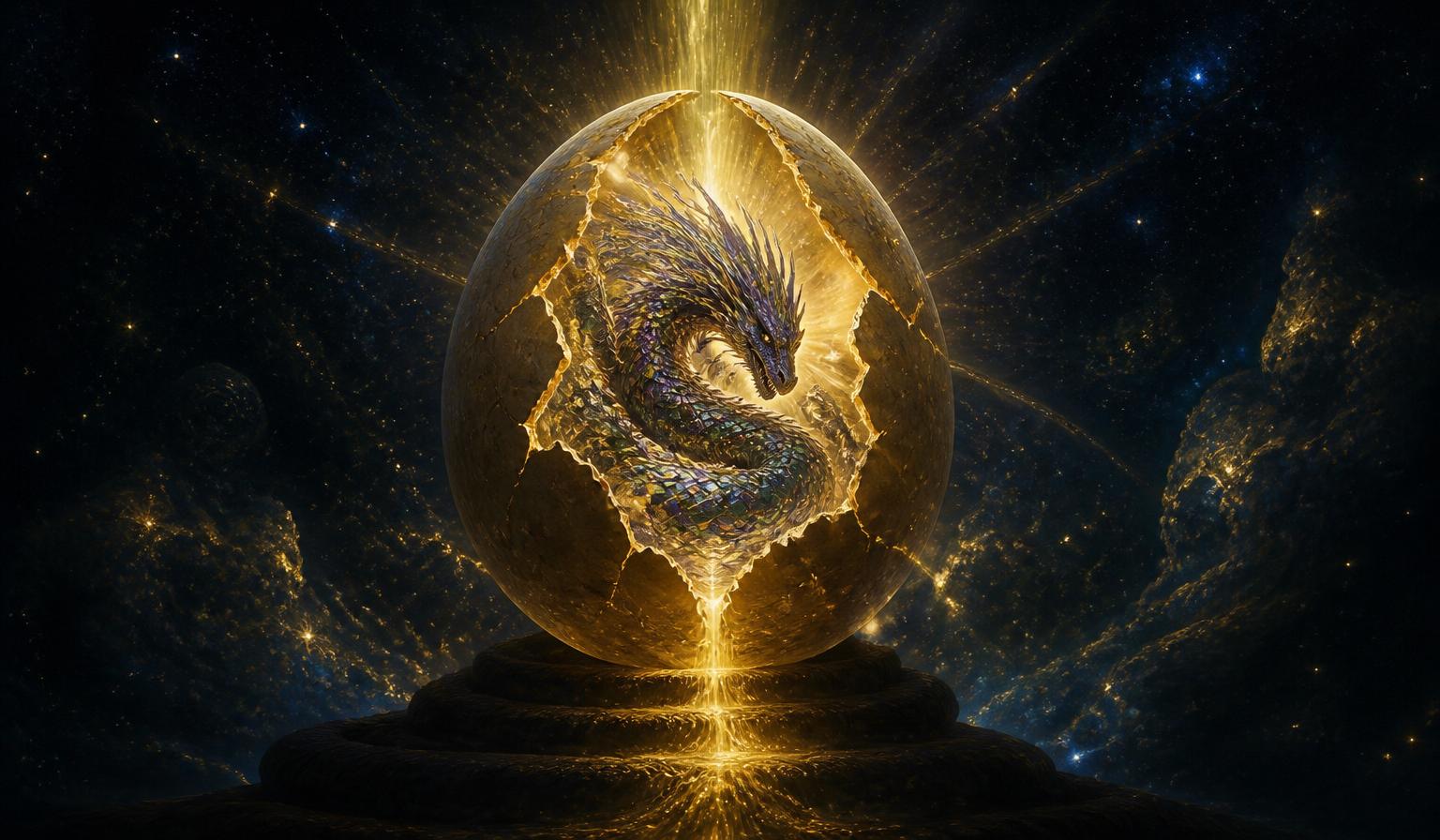
Korean tradition keeps a creature that exists almost nowhere else in the world's mythologies: a dragon that is not yet a dragon.
They call it the imugi --- a great serpent of the deep pools and cold mountain caves, magnificent already, but unfinished. To become a true dragon, a yong, the imugi must wait. The classic figure is a thousand years: ten centuries of stillness in dark water, and not idle stillness --- the tellings insist the imugi must spend the time cultivating: gathering virtue, doing quiet good, ripening its nature, until at last it is granted (or catches, falling from heaven) the yeouiju, the luminous wish-fulfilling pearl, and rises through the storm clouds transformed. Some imugi fail --- grasp too early, force the ascent --- and fall back for another age. The mythology is unblinking on the point: what separates the serpent from the dragon is not power. It is ripeness, and ripeness cannot be seized. It can only be undergone.
Half a world away and twenty-five centuries earlier, the Orphic mystery schools of Greece taught initiates a cosmogony that begins with the same image inverted to cosmic scale. In the beginning, they said, was an egg --- and around the egg, coiled in tight spirals, a serpent. When the shell divided, out stepped Phanes, the shining firstborn, the light by which everything else would come to be. Not light from a word, not light from a battle: light from an incubation --- the universe itself hatched, after its own unrecorded age of waiting, from an egg the serpent had been holding all along. India's oldest hymns know the same beginning as Hiranyagarbha, the golden womb-egg floating on the primordial waters, source of gods and worlds. China tells of Pangu, asleep inside the cosmic egg for eighteen thousand years while heaven and earth ripened intermingled around him, until the day he woke and stood up, and the shell became sky and ground. Vietnam goes further and hatches not the cosmos but itself: the dragon lord Lạc Long Quân and the mountain fairy Âu Cơ, whose union produced a sac of one hundred eggs, from which emerged the hundred ancestors of the Vietnamese people. An entire nation that answers the question "where do you come from?" with: dragon eggs.
And on a bluff above a creek in Ohio, someone --- around two thousand years ago, in a culture whose name we do not know --- built the answer in earth. Serpent Mound uncoils for four hundred meters along the ridge, its curves aligned to the standing sun, and at its head the open jaws close around an oval of raised earth: an egg, held forever at the exact threshold between swallowed and spoken. Archaeologists still debate what the oval "represents." The mound itself has never been confused. It is the world's largest sculpture of the single most persistent idea in human myth: the serpent and the egg belong together, and the whole drama of existence happens at the point where they touch.
Why this image, everywhere, always? Because the egg solves a problem every deep tradition eventually faces: how to speak about potential --- about the real presence of what has not yet appeared. An egg is not an absence. Hold one and you hold something complete, alive, and entirely hidden; every instruction for a future being is already inside, needing nothing added --- nothing except time and warmth. The egg is the world's word for latency that can be trusted. And so wherever a tradition needs to say the treasure exists but the hour has not come, an egg appears --- or its twin, the pearl. The dragons of China spend eternity pursuing a flaming pearl they never quite swallow: wisdom as the luminous sphere always just ahead of the jaws, desire's horizon made visible. The Himalayan masters concealed their deepest teachings as termas --- treasures hidden in rock and lake and mind, sealed until the generation that could receive them. The Nāgas of India held the perfection-of-wisdom scriptures in their underwater kingdom for centuries, not as jailers but as incubators, until humanity was ready to be shown them. In every case the grammar is identical: concealment is not loss. Concealment is timing.
Which brings the teaching home, because we are --- every one of us --- keepers of eggs, and mostly bad ones. Our culture has essentially one verb for potential: unlock. Release it, disrupt it, hack it, ship it now. Against this, the whole egg-lore of the species stands as a single objection with a thousand illustrations. The imugi that lunges for the pearl too early falls for another age. The folk tales bristle with warnings about eggs broken open ahead of time: what emerges is always wrong --- unfinished, monstrous, or simply dead. The basilisk, Europe's nightmare hatchling, is precisely the egg gone wrong: the impossible egg, wrongly brooded, hatching venom. The traditions could not be clearer. The shell is not the obstacle to the dragon. The shell is the dragon's teacher. Everything the future being will need --- its strength, its coherence, its readiness for air and light --- is built in the dark, under pressure, unseen, on a schedule that does not negotiate.
And yet the eggs are not indifferent to us. This is the second half of the teaching, and the stranger half. Almost nowhere does the egg simply hatch on its own, in secret, unattended. The Orphic serpent coils around it. The mound's jaws hold it. Doña Flor's tradition --- and every tradition like hers --- insists the egg must be carried, spoken to, brought to the water, greeted. The imugi, in many tellings, needs a human witness at the moment of ascent; one distracted or fearful watcher and the rising fails. The waiting intelligence inside the shell is doing its half of the work, but the hatching itself is a meeting: readiness within answered by recognition without. What sleeps in the egg is not waiting to be rescued. It is waiting to be recognized --- and it is using the time.
So the practice this old lore leaves us is double, like the image itself. Toward what is gestating in us --- the book, the calling, the healing, the self that is not ready --- it counsels the imugi's discipline: stop clawing at the shell; the dark is not your enemy, it is your workshop; cultivate, and let the thousand years be however long they are. And toward the eggs in our keeping --- the people, the projects, the young, the sleeping gifts of those we love --- it counsels the serpent's coil: warmth without pressure, attention without demand, presence at the threshold without one premature crack of the shell. Hold the egg the way the mound holds it: jaws open, forever, at the point of reverence.
The thousand years, the lore quietly implies, are rarely literal. Ripeness keeps its own calendar, and sometimes the calendar says now. You will know the difference the way the imugi knows the pearl: not because you seized the moment, but because the moment, complete at last, rose to meet you --- and everything you built in the dark turned out to be wings.
The Inner Circle keeps a practice companion for every station — Join.