Nine Dragons Rising
Tsangpa Gyare's vision, Druk Yul, and why the happiness kingdom is named for the dragon.
By Prof. Luis Miguel Gallardo··5 min read
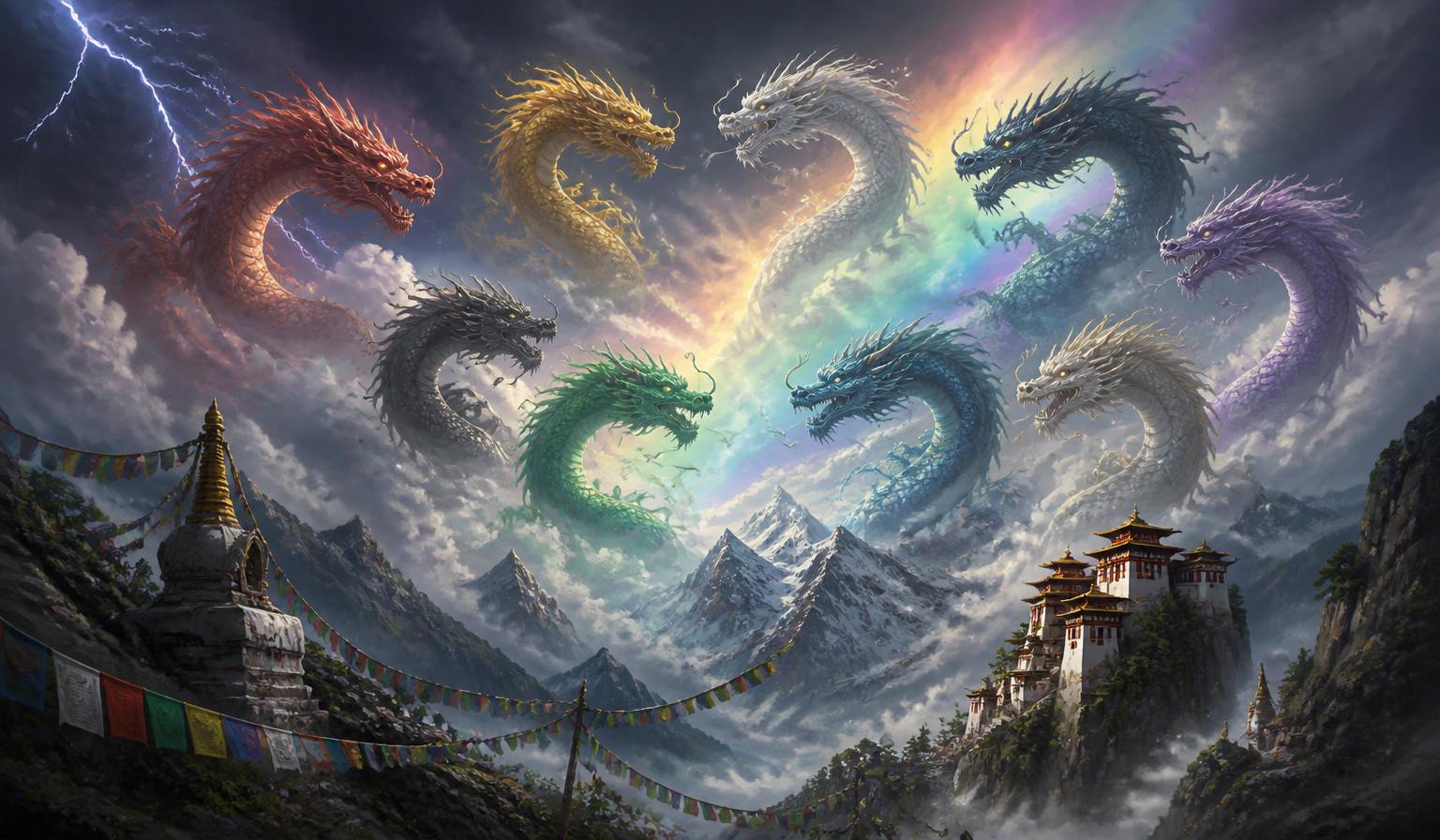
Around the year 1206, in the Nam valley of central Tibet, a master named Tsangpa Gyare Yeshe Dorje arrived at a piece of ground where he intended to consecrate a monastery. As the ritual began, thunder broke across a clear sky. The tradition tells that he looked up and saw nine dragons rise out of the earth itself --- nine, roaring as they climbed into the heavens, while flowers rained down out of the emptiness.
He read the omen the way masters do: not as decoration, but as instruction. He named the place Namdruk --- Sky Dragon --- and his lineage the Drukpa: those of the dragon. Within a few generations that lineage crossed the high passes of the Himalayas and took root in a land of cloud forests and vertical valleys, which came to be called, after it, Druk Yul: the Land of the Thunder Dragon. Its people are the Drukpa. Its kings, to this day, are crowned Druk Gyalpo --- Dragon Kings. When thunder rolls down the Paro or Punakha valleys, Bhutanese tradition hears the dragon's voice.
Hold the founding image still for a moment, because every detail is doing work. The dragons do not descend from heaven as a blessing conferred from above. They rise out of the ground --- out of the earth of the very place being consecrated --- as if the act of consecration did not summon something new but woke something that was already there, sleeping underfoot. Nine of them. And their rising is not silent illumination but thunder: the kind of truth that startles, that announces itself to the whole valley at once, that is always followed --- as thunder is --- by rain, by fertility, by the fields drinking.
Nearly every contemplative tradition on Earth keeps some version of this secret: that the sacred is not imported but awakened; that power sleeps in the ground of the ordinary until an act of full attention calls it up. India describes a serpent-energy coiled and dormant at the base of the human spine. The Maya built a pyramid on which, twice a year, a serpent of light descends nine levels to wake its stone twin. Galicia hides radiant beings under its oldest rocks, waiting for the one visitor who will not flinch. Tibet's gift to this universal grammar is the plural, and the direction: not one dragon but nine, and not descending but rising --- the fully gestated sacred, breaking upward into daylight, all at once, in company.
Nine is worth pausing on. It is the last of the single digits, the threshold number, the count of completion-before-birth --- nine moons of human gestation, nine tiers of the Maya underworld, nine platforms on the pyramid at Chichén Itzá, nine worlds strung on the Norse world-tree. Traditions that never met agree that what is fully ripened arrives through nine. Tsangpa Gyare's vision belongs to that lineage of nines: it is an image of readiness --- of everything that had been maturing in the dark of the earth reaching, in a single thunderclap, the moment of emergence.
Now leap eight centuries.
In 1972, the fourth Dragon King of Bhutan, Jigme Singye Wangchuck --- then one of the youngest monarchs on Earth --- articulated a principle that has since traveled to every parliament, university, and policy institute on the planet: Gross National Happiness is more important than Gross National Product. In four words of Himalayan common sense, the dragon kingdom quietly inverted the operating system of the modern world. Progress, Bhutan proposed, is not what a nation extracts, produces, and accumulates; progress is the flourishing of its people --- their inner development, their culture, their communities, the living land itself. GNH became a constitutional mandate, then a measurement framework, then a global movement; the United Nations' resolutions on happiness and well-being, the world happiness reports, the entire contemporary field of well-being economics all stand downstream of that declaration. So does every framework --- including our own work on Happytalism and Fundamental Peace --- that dares to treat human flourishing as the true bottom line of civilization.
It matters --- it matters enormously --- that this proposal came from the only country on Earth named for the dragon.
Because look at the flag. On a field split of gold and orange rides Druk, the white thunder dragon, and in each of his four claws he grips a jewel. Ask what the jewels mean and the tradition answers: the wealth and the protection of the people. Now look closer, at the detail a designer of empires would never have chosen: the claws are open. The dragon does not hoard the jewels; he carries them, displays them, holds them the way a hand holds water --- in trust, in circulation, on behalf of everyone beneath his flight. Compare him to his Western cousins: Fáfnir, who murdered for gold and whose hoarding literally transformed him into a dragon; the worm of the northern legends coiled around its buried treasure, poisoning the land it refuses to share. The whole moral history of the dragon in a single design choice: closed claws make a monster; open claws make a guardian. That flag may be the oldest infographic of well-being economics in existence --- wealth held openly, for the flourishing of all, under the sign of awakened power.
This is why the story of the nine dragons and the story of Gross National Happiness are not two stories. A civilization's dragons tell you what it believes about power. Where the dragon is a hoarder to be slain, the economy will be an arena of extraction and conquest --- slay, seize, accumulate. Where the dragon is a thunder-voiced guardian holding jewels in open claws, another economics becomes thinkable: power as stewardship, wealth as circulation, the treasure existing for the people and not the reverse. Bhutan did not derive GNH from its mythology by syllogism, of course. But myths are the load-bearing walls of the possible. The nation that had spent eight hundred years praying beneath an image of generous, awakened power was the nation capable of saying out loud what the industrial world could not: that the point of it all is happiness --- free, conscious, shared.
And so the vision at Namdruk keeps completing itself. Nine dragons rose from the ground because the ground was ready. Eight centuries later, a measure of progress rose from a small Himalayan kingdom because humanity's ground --- exhausted by a century of counting the wrong things --- was becoming ready too. The Ninth Wave of the Maya seers, the ninth month of every gestation, the nine sleeping forms of every deep tradition: all of it converges on the same annunciation the thunder made over the Nam valley. What has been maturing in the dark of the earth --- in the dark of us --- is done with sleeping.
Listen for the thunder. It is always followed by rain.
The Inner Circle keeps a practice companion for every station — Join.