Look Upon the Serpent and Live
Nehushtan, Medusa's mirror, and the healing gaze.
By Prof. Luis Miguel Gallardo··5 min read
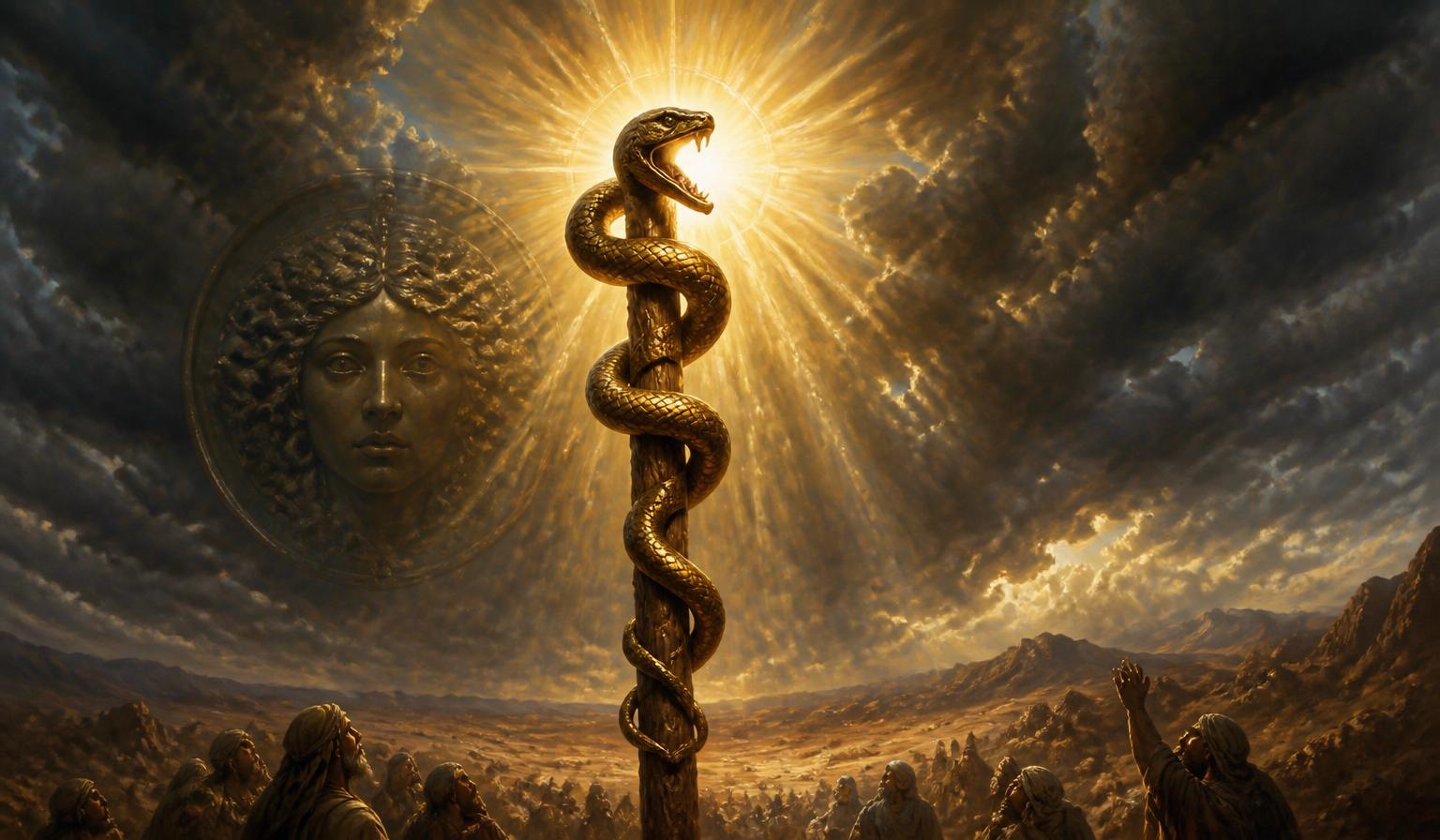
There is a strange story in the Book of Numbers, so strange that the tradition itself never quite domesticated it. The people, wandering the wilderness, are beset by fiery serpents; the bites are killing them. They cry out, and the remedy that comes is not the removal of the snakes. It is this: make a serpent of bronze and set it on a pole; and everyone who is bitten, when he looks at it, shall live.
Sit with the mechanics of that for a moment, because they are the whole article. The wound is serpent; the cure is serpent. Not serpent avoided, banished, or destroyed --- serpent represented, raised up, and beheld. The instruction does not ask the bitten to feel anything, believe anything, or do anything except turn their eyes toward an image of exactly what struck them. The venom, the story insists, is answered by the gaze. Israel's later history added a sober epilogue: centuries on, King Hezekiah smashed the bronze serpent --- Nehushtan, it had come to be called --- because the people had begun burning incense to it. The remedy, clung to and worshipped instead of used, had curdled into one more idol. Even medicine, the tradition warns, becomes poison the moment you stop looking through it and start bowing to it. But the original prescription stands, uncanny as the day it was written: look upon the serpent, and live.
Greece received the same discovery from the opposite direction --- as a warning first, and only then as a technique. Medusa is the figure of the absolutely unbeholdable: the woman with serpents for hair whose direct sight turns the looker to stone. Every detail of her story deepens the psychology. She was not born monstrous; the best-known telling makes her a woman violated in a goddess's temple and then punished for it --- horror layered on injustice, the kind of history that becomes unlookable precisely because looking at it honestly would indict too much. And what does her gaze do? It petrifies. It does not kill; it freezes --- the exact signature, a modern clinician might note, of trauma met head-on and unprepared: the system turned to stone, motion and feeling suspended, life continuing around a person who has stopped. Medusa is the truth about certain contents of experience: stared at nakedly, before their time, they do not heal us. They halt us.
And yet she had to be approached --- the story requires it --- and here Greece delivers its technique, one of the most precise images in all mythology. Perseus does not conquer Medusa with a stronger stare. He is given, by wisdom herself, a polished shield, and he approaches watching not the Gorgon but her reflection --- the unbearable, beheld indirectly, at one remove, in a surface he controls the angle of. By the mirror he comes close enough; by the mirror he acts; and from the severed neck springs --- the detail no one expects --- Pegasus, the winged horse, inspiration itself, which had been waiting inside the horror all along. The reflected gaze does not merely survive the unbearable. It releases what the unbearable was holding.
Every consulting room on Earth now runs on some version of Perseus's shield, whether or not anyone names it. The traumatic content that cannot be faced raw is approached in reflection: told as narrative, at a distance the teller controls; drawn, written, dramatized, titrated; witnessed in the mirror of another person's steady attention, which holds the image so it need not be met eye to eye. The whole modern craft of exposure --- approaching the feared thing gradually, safely, repeatedly, until the nervous system relearns it --- is the bronze serpent on its pole: the wounding image, elevated, framed, and beheld on purpose until beholding it stops wounding. None of this is to collapse ancient scripture into technique; it is to notice, with proper awe, that the old stories carried the operating manual for the psyche's hardest procedure millennia before anyone could say why it worked. Look --- but lifted. Look --- but mirrored. The dose of the gaze is the medicine or the poison.
Egypt, meanwhile, contributed the third principle, the one without which the other two exhaust the looker: scheduling. Every night, the Egyptians knew, the serpent Apep --- dissolution itself --- attacked the boat of the sun as it crossed the dark hours; and every night he was defeated, and the sun rose, and nothing about the victory prevented the next night's battle. Chaos, in the Egyptian understanding, is never conquered once. So the temples institutionalized the gaze: rites of "overthrowing Apep," performed on the calendar, in effigy --- images of the serpent made, named, and ritually undone, by priests, on behalf of everyone, regularly. Not because the serpent was at the door that particular morning, but because a civilization that only faces its dissolving forces during emergencies will meet them unpracticed. It is the wisest of the three moves and the least flattering: the healing gaze is not an event. It is a hygiene --- a rhythm of turning toward the difficult in representation, in ritual, in scheduled honesty, so that when the real serpent strikes, the eyes already know the shape.
Raised, mirrored, rehearsed: three adjustments of one instrument. And underneath all three lies the single discovery the traditions share, the reason this article sits in a library of serpents: the difference between the gaze that petrifies and the gaze that heals is not courage, and it is not the content of what is seen. Medusa and Nehushtan are, after all, the same image --- a serpent-crowned terror --- met with different optics. What differs is the relation of the looking: its distance, its frame, its timing, its purpose. The stare that freezes is raw, unchosen, and alone. The gaze that cures is prepared, angled, communal, and deliberate --- a looking that has been given a pole, a shield, a rite to travel through. We are not asked to be creatures who can behold anything nakedly. We are asked to be creatures who know how to build the beholding: to raise what bit us where it can be seen instead of stepped on; to find the polished surfaces --- the page, the story, the trusted witness --- in which the unbearable consents to appear; and to keep the appointment nightly, before the emergency, the way Egypt kept it for three thousand years.
The wilderness story never says the serpents left. Read it again: the snakes remain in the camp; only the dying stops. That is the honest promise, and it is enough. The serpents of a life are rarely removed. But somewhere in the middle of the camp, available to anyone bitten, stands the thing the old instruction knew how to build --- the wound itself, lifted into visibility, transformed by elevation into remedy.
Look up. That is the entire prescription, and it has not expired:
look upon the serpent, and live.
The Inner Circle keeps a practice companion for every station — Join.