Kiss the Serpent: The Mouras of Galicia
Desencanto as the original shadow-work protocol.
By Prof. Luis Miguel Gallardo··5 min read
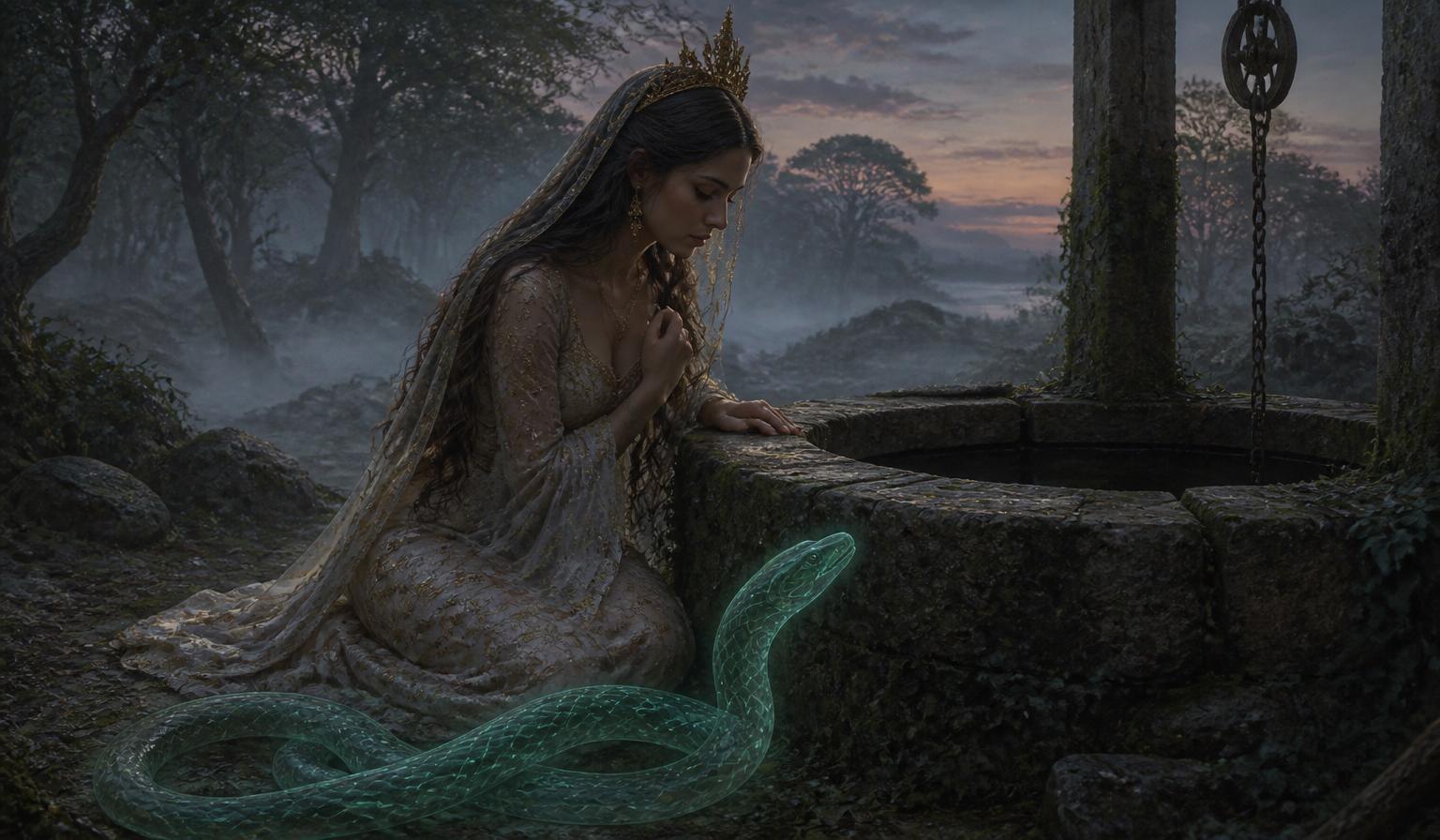
Long before Rome arrived, Greek and Latin geographers had a name for the Atlantic corner of Iberia: they associated it with Ophiussa --- the land of serpents. They meant it, presumably, as natural history. Two thousand years later, walk the green hills of Galicia and northern Portugal and you will find that the name was prophecy. The serpents are still there. They are simply not what the geographers imagined.
Ask in the villages --- or ask the folklorists who spent the twentieth century writing it all down before it faded --- and you will hear of the mouras. The name misleads: despite its sound, the moura of legend is no Moorish woman, and scholars trace the word to far older roots tangled with the pre-Roman otherworld and its dead. The moura is a being of radiance. She appears at dawn, most often on the morning of San Xoán --- midsummer --- sitting at the mouth of a dolmen or beside a spring below a ruined hillfort, combing her long golden hair with a comb of gold, or spinning golden thread from a distaff, or laying out impossible treasures in the first sun. She dwells inside the ancient places: under the megaliths, within the castros, beneath standing stones that were old when the Romans came. She is bound there by an encanto --- an enchantment --- and she is waiting.
And here the legends make the move that lifts them from charming folklore into the deepest register of European memory: the moura is often a serpent. In tale after tale, collected from Fisterra to the Minho, the being under the stone shows herself as a great snake --- sometimes winged, sometimes crowned, sometimes a woman to the waist and serpent below. Her freedom, and the treasure she guards, hang on a single ordeal, and it is never a battle. Someone must approach the serpent and perform an exact act of acceptance: kiss her on the mouth; or carry her wrapped around his neck in silence to a certain place; or feed her milk from his own hands; or simply not recoil when she rears. The rules are strict as liturgy. Flinch, cry out, drop her, break the silence --- and the enchantment redoubles; the moura sinks back beneath the stone, sometimes weeping that she must now wait another hundred years, and the failed liberator is lucky to escape with his life. Hold steady, and the serpent transforms: the radiant woman stands free in the morning light, and the gold is real.
Where did she come from, this serpent-woman under the stones? The most compelling reading --- advanced in different keys by Galician and Portuguese scholars alike --- is that the mouras are the memory of what Europe buried. When the new religion arrived, the old sacred did not vanish; it went under. The goddesses of spring and stone, the ancestral mothers of the megalith-builders, the whole feminine face of the holy was pushed out of the churches and survived where the plough could not reach: inside the dolmens, which are, after all, the tombs and temples of Galicia's first peoples. The moura is that exiled sacred, localized --- still radiant, still wealthy beyond counting, still at her spinning (the oldest gesture of the Fates), but enchanted: present and unrecognized, alive and untouchable, sleeping in plain sight under every old stone in the country. Galicia did not lose its goddess. It encrypted her --- and kept the key in a folk tale.
Around her, the tradition arranges a whole serpent ecology. On the Costa da Morte, at Gondomil, a carved winged serpent --- a true stone dragon --- coils at the foot of a Christian cross: the Pedra da Serpe, tied to the legend that a saint stamped his foot and drove all the serpents of the region beneath that stone, where they sleep still. The gesture could not be more legible: the old power not destroyed but pinned, officially capped by the cross, unofficially venerated ever since. Eastward, in the mountains of Asturias, the cuélebre grows too vast for its cave guarding treasures and enchanted maidens, and its very saliva hardens into a stone that heals all illness --- the monster's body producing the medicine, shadow secreting gift. And in Redondela, every Corpus Christi, the town still dances its dragon: the Coca, paraded and ritually fought, whose defeat is celebrated and whose presence is indispensable --- a community that kills its dragon annually precisely so that it may keep it forever. Meanwhile the human counterpart of all this otherworld walks the same villages: the meiga, the wise-woman of herbs and evil-eye and its undoing, about whom Galicia coined the most Galician sentence ever spoken --- Haberlas, hainas: as for their existing, exist they do.
Read as a system, this is not a collection of quaint survivals. It is a coherent doctrine, preserved in narrative form, about what a person --- or a civilization --- must do with its buried sacred. And its precision puts much of modern psychology to shame.
First: the treasure and the serpent are one. There is no version in which you get the gold while avoiding the snake. What was exiled and what was precious went under the stone together, because they were never two things.
Second: force is useless and effort is beside the point. No moura is freed by strength, cleverness, or virtue in the abstract. The single operative faculty is the quality of the gaze at the moment of encounter --- the capacity to behold the feared form without flinching and greet it as what it is. The kiss is not romance; it is recognition with the whole body.
Third --- and this is the tradition's dark mercy --- failure is not neutral. Every flinch deepens the enchantment. What we cannot bear to look at does not wait for us unchanged; it sinks further, waits longer, and the next encounter will be harder. The legends are unsentimental about the cost of our recoiling, which is exactly what makes their promise trustworthy: the door never closes entirely. Another hundred years, the moura says. Not never. The buried feminine of Europe --- the buried anything of anyone --- keeps its appointment across any span of forgetting.
On San Xoán morning, people in Galicia still gather herbs and wash their faces in flower-water at dawn, the hour the mouras come out to comb their hair. Most would smile if you called it a liturgy of the exiled goddess. But the old stones are still there, on hills all over the country, and the story still knows exactly what it asks of us. Somewhere beneath the life you have built --- under the oldest stone in your own landscape --- something radiant took serpent form the day it went unwitnessed. It is not angry. It is spinning gold, and waiting, and it has left you the instructions in a hundred village tellings: come at dawn; come alone if you must; and when it rises before you wearing the one face you fear ---
do not flinch.
The Inner Circle keeps a practice companion for every station — Join.